I've got a rule now: if the part number stamped into the part doesn't match the part number in my order, I don't install it. That rule sounds obvious. It took me about nine years to follow it every time.
I work in automotive parts manufacturing. I've spent most of that time around stamping dies, forged driveline components, CNC-machined housings, and shipping boxes. The work taught me that a part that looks right isn't automatically right. At work, every part has traceability. At home, I used to trust the label. That's how I ended up with the wrong GX470 exhaust manifold, a ball joint I should have replaced sooner, and two EXEDY clutch kits from the same delivery on the same workbench.
Here's the story, and the checklist I now use for every parts order.
Two EXEDY boxes, one workbench
Last spring, my 2006 WRX project finally needed a clutch. I run extra boost, so I ordered the EXEDY stage 2 clutch and flywheel kit. Around the same time, my neighbor asked me to order a stock replacement for his daily driver. That's the EXEDY 07099 OEM replacement clutch kit.
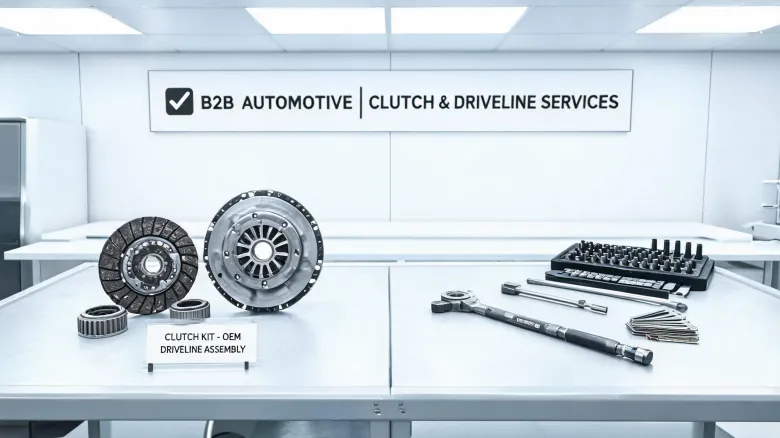
Those two kits are not the same thing. The EXEDY 07099 OEM replacement clutch kit is a factory-style kit: a stock disc, a stock pressure plate, release bearing, and pilot bearing. It's meant to give you the same pedal feel and torque capacity as the original clutch. The EXEDY stage 2 clutch and flywheel kit is a performance setup. It has a stiffer pressure plate, a different friction disc, and a lightweight flywheel, and it's built for higher torque and harder use. Both parts come in boxes with EXEDY printed on them. That doesn't make them interchangeable.
The box said one thing, the parts said another
Both orders arrived on a Friday afternoon. I stacked the boxes on my workbench and didn't open them until the next morning. That's the first mistake most of us make: we treat the shipping box as proof.
By Saturday, I had the WRX on jack stands and the transmission out. I opened the box labeled EXEDY stage 2 clutch and flywheel. Inside was a stock-style clutch kit and no flywheel. I opened the second box, and there was my stage 2 clutch and flywheel. The warehouse had swapped the contents before shipping. The cartons were labeled correctly, but the parts were in the wrong boxes.
It took ten minutes of comparing the stamped part numbers on the pressure plate and the clutch disc before I fully trusted what I was seeing. If I had bolted the 07099 kit in without checking, it would have looked fine going in. On some applications it won't line up at all; on others it bolts up and then fails under load. Either way, you don't find out until the car is back on the ground.
At that point, I had a decision: seal the boxes up and file a return, or open the second carton, photograph everything, and confirm. The upside of opening the second box was finishing the clutch job that weekend. The risk was that the vendor might think I had mixed the parts myself. I took photos of both labels first, then opened the second box. It was the right call.
That near-miss didn't cost me money. The earlier mistakes did. I've documented fourteen significant parts mistakes over the years, totaling roughly $8,700 in wasted parts, return shipping, and lost weekends. The clutch was proof that I still needed the same process discipline in my garage that I rely on at work.
The GX470 exhaust manifold that started the habit
My daily driver is a Lexus GX470 with over 200,000 miles. If you own a 2UZ-FE truck from those years, you know the sound: a ticking noise on cold start that slowly fades as the engine warms up. The GX470 exhaust manifold is a known weak point on that engine, and mine was cracked.
The first time I bought a replacement, I searched by the vehicle year, picked a listing that looked right, and ordered it. I didn't verify the casting number or which bank the old part came from. When I pulled the old manifold and set the new one next to it, the brackets didn't line up. The part was for the other side of the engine. A $230 mistake plus ten days of waiting, and my truck sat on jack stands the whole time.
That job taught me to write down the part number and the position of the old part before I order anything. The clutch near-miss was the same lesson wearing different clothes.
What is the ball joint on a car?
A friend asked me that exact question while I was doing front-end work a few months later.
Short answer: a ball joint is the ball-and-socket pivot that connects a control arm to the steering knuckle. The wheel mounts to the knuckle, so the ball joint lets the wheel move up and down as the suspension compresses while still allowing the knuckle to turn left and right. On many front suspensions, the lower ball joint also carries a significant amount of the vehicle's weight.
I should have asked that question sooner myself. I once ignored a torn lower ball joint boot on my GX470 because the joint didn't make noise yet. Within a few thousand miles, it started clunking over bumps and on sharp turns. I replaced both lower ball joints after that and stopped trusting the idea that a silent ball joint is always a healthy one.
If your mechanic says you have play in a ball joint, or you can see a torn boot, don't put it off. A ball joint that separates at speed is not a repair bill; it's a safety event.
Flotec sump pump oil: it's not always a maintenance item
A few weeks later, the same friend called from his basement. His sump pump had stopped working, and someone told him the oil needed to be changed. The pump was a Flotec, so he searched Flotec sump pump oil and ended up asking me whether he should crack the motor open.
I looked up the manual for his model. A lot of Flotec submersible pumps have an oil-filled motor that is sealed at the factory. There's no dipstick, and changing the oil isn't a scheduled service. In his case, the real problem was a blocked inlet screen and a float switch that needed cleaning. Opening the sealed motor would have created a problem that didn't exist.
The lesson was the same as the clutch and the manifold: check the actual specification before you touch anything. A brand name tells you the part is probably good. The model number tells you whether it belongs in your application.
The checklist I use now
Here's the checklist that runs my garage now. It's short, and it has saved me more times than I can count:
- Write down the part number on the old part, or look up the factory parts diagram for your VIN, before ordering anything.
- Order by that part number. Don't rely on year, make, and model alone.
- When the shipment arrives, compare the label, the packing slip, and the part number stamped on the actual part.
- If you're too tired or too rushed to check, stop. The job will wait. A wrong install won't.
At work, this kind of process has caught 47 potential errors in the last 18 months and saved us far more downtime than it cost. The garage version works the same way. My experience is limited to the vehicles and parts I've handled, so I can't tell you that every EXEDY kit or every Flotec model works exactly like the ones I've seen. That's the whole point: the model number and the part number tell you what you need to know, not my memory.
The label is a suggestion. The part number is the instruction. When they disagree, stop and check the part itself.
The EXEDY 07099 OEM replacement clutch kit and the EXEDY stage 2 clutch and flywheel are both solid products. The right one for your car depends on the exact part number required by your engine, transmission, and use case. Verify the fitment before you drop the transmission. Trust me on that one.