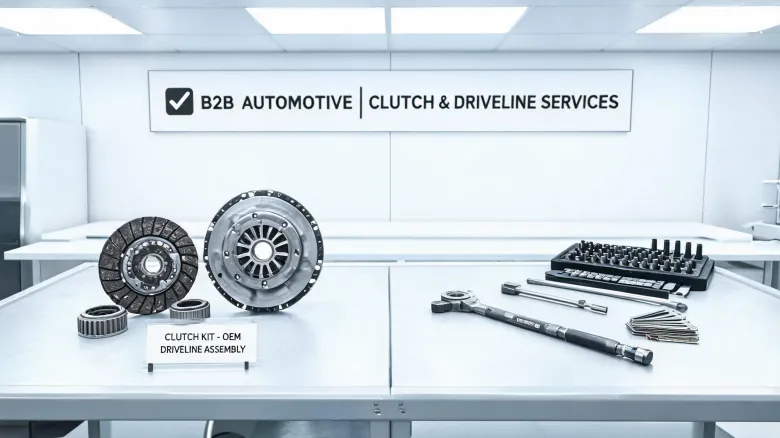
There isn't one right clutch kit for the 1992-2000 Honda Civic. If you've spent any time in Civic forums, you've seen the arguments: OEM is the only choice, no—buy a stage kit, or just buy the cheapest one and pocket the difference. Everyone sounds sure. Most of them are answering different questions. That's because 'which clutch should I buy' depends on whether your Civic is a daily driver, a project car, or maybe whether the clutch is even the part that failed in the first place.
My perspective comes from quality work at Exedy. I review clutch kits and stamped clutch components before they ship—roughly 200 part numbers a month. In Q1 2025 I rejected about 3% of first-run deliveries for spec drift: diaphragm finger heights off by a few tenths of a millimeter, cover tolerances outside the drawing, small stuff that no visual inspection catches. A driver won't notice at the parts counter; they'll notice 6,000 miles later as a heavier pedal or a clutch that releases late. So I have a habit of slowing down the selection process before recommending anything.
And the same habit applies when someone asks whether their problem is battery vs alternator, whether they should swap a 9007 headlight bulb, or how to choose mounting hardware. Diagnose first. Then match the spec to the actual use of the car. That order saves more money than any bargain part.
Three situations that get mixed up
In my experience, the 92-00 Civic questions I receive fall into three groups:
- Situation 1: The stock daily driver. The car is close to factory, it's used for commuting, and the goal is a normal Civic driving experience again. The clutch's job here is smooth engagement and long life, not maximum grip.
- Situation 2: The modified or track car. The engine has been built, swapped, or boosted. The problem isn't engagement comfort; it's torque capacity. A stock-spec disc won't hold the power, so heat and slip become the real enemies.
- Situation 3: The car that doesn't have a clutch problem at all. It won't crank, needs a jump every week, or dies at idle then restarts. That's an electrical system investigation—battery vs alternator usually—and no clutch kit will fix it.
Once you know which situation you're in, the recommendation becomes fairly clear. Until then, every opinion you read is guesswork.
Situation 1: Stock daily driver—OE clutch kit
If the Civic is stock or close to it, the part I'd start with is the Exedy OE clutch kit for Honda Civic (1992-2000). 'OE' means the friction material, damper tuning, and pressure plate load follow the original factory specification. That's not the flashy answer, but it's the correct one. The original clutch was matched to the stock engine's torque curve, and an organic-faced disc is the right material for street stop-and-go driving.
Here's the part that surprises people: a higher-performance clutch can actually wear out faster on a stock daily driver. Put another way—when engagement is aggressive, drivers end up slipping the clutch more in traffic to keep launches smooth. The extra heat wears the disc faster than normal driving would. I've tested returned 'racing' clutches with a few thousand street miles that looked cooked, and the clutch wasn't defective. It was just matched with the wrong situation.
There's also a quality trap hiding in budget 'OE replacement' clutches. I once bench-tested a pressure plate that a customer bought online because pedal effort was way too high and engagement felt harsh. Measured clamp load was about 30% above the factory print spec. The plate wasn't broken; it was a heavy-duty part from another supplier, listed as an equivalent. On paper, more clamp sounds like an upgrade. On the street, it means a tiring pedal and a second transmission pull when you decide you can't live with it. The money saved on that plate was less than the labor cost of the redo.
That's the value-over-price logic I use in quality work. The cheapest part is rarely the lowest-cost part once you count installation time, downtime, and the chance of doing the job twice.
Situation 2: Built or track Civic—stage 2 cerametallic clutch
Now let's say the Civic is a different animal. Maybe you swapped in a B-series, added boost, or you're doing track days where the car sees sustained high rpm and hard shifts. A stock organic clutch will slip when torque rises, and the slippage cooks the facings. This is where I point people toward the Exedy Stage 2 cerametallic clutch kit 08951.
The 'cerametallic' part matters. The friction material is designed to handle higher heat and offers more holding force than organic material at the same clamp load. That's what you need when the flywheel is seeing harder launches and the engine is making well above stock torque. The kit's torque rating and pedal characteristics are intended for a modified street or strip car, not a commuter.
But I won't tell you ceramics are universally better, because they're not. Cerametallic engagement is more abrupt, especially from a stop. If this car is your daily and you sit in rush-hour traffic, the harsh engagement will get old fast. It doesn't mean the clutch is faulty. It means the scenario has changed: if the car is both modified and daily-driven, you're making a compromise, not a perfect choice.
If the engine is basically stock and the stage kit is just for 'better feel', that's the wrong reason. A clutch can't add horsepower; it can only transmit what the engine already makes, and a ceramic disc will just make that less pleasant to handle in traffic.
Before you install a Stage 2 kit, also check the flywheel condition. Ceramic material doesn't tolerate a glazed or uneven flywheel surface the way organic material sometimes masks it. If the flywheel has hot spots or blue marks, machine it or replace it while the transmission is out. Skipping that step turns a quality clutch into a chattering one, and then you'll blame the wrong part. (Should mention: replace the pilot and release bearings at the same time. Old bearings are the other common reason a fresh clutch job feels wrong.)
Situation 3: Won't start or dies at idle—battery vs alternator
The third situation doesn't need any clutch at all. If your Civic cranks slowly, needs a jump after sitting overnight, or dies at a stoplight, no clutch kit in the catalog is going to help. The real question is battery vs alternator.
You can diagnose this at home without a scan tool:
- Let the car sit overnight, then check battery voltage with a multimeter. A fully charged battery reads about 12.6V. Below 12.4V means it's undercharged—or not holding a charge.
- Watch the voltage while someone cranks the engine. A healthy battery usually stays above 10V during cranking. If it drops hard, the battery is weak or has an internal problem.
- Start the engine and measure voltage at the battery again. With the alternator charging, you should see roughly 13.8V to 14.7V at idle or slightly above. Below about 13V suggests the alternator isn't doing its job.
- If the battery is more than four or five years old, get it load-tested before buying an alternator. Many parts stores do this for free. It will save you from replacing the wrong part.
The most frustrating cases I see are the alternators that get replaced while the battery can't hold a charge. The new alternator may be charging fine; the battery just can't store the energy. A few days later the owner is back, convinced the alternator is bad, and the real fix was the battery all along. The same principle applies in reverse: if the battery tests healthy and charging voltage stays low, replacing the battery won't fix an alternator that stopped charging.
The same discipline applies to headlights, by the way. If a 9007 headlight bulb burns out, changing it is simple. But if the headlights dim at idle and brighten when you rev the engine, that's a charging system symptom, not a bulb symptom. Swapping the 9007 headlight bulb in that case is buying a part without treating the cause. You'll end up with a new bulb and the same problem.
How to tell which situation you're in
Here's how I'd make the call in a few minutes:
- If the engine revs but road speed doesn't rise smoothly in gear, it's clutch slip—ask whether your build is stock or modified, and choose Situation 1 or 2.
- If the engine cranks weak, needs frequent jumps, or dies at idle and restarts later, skip the clutch discussion and start with the battery load test. That's the battery vs alternator branch.
- If your Civic is stock and used as a daily driver, the OE kit is the lower-risk choice. If you're planning boost or regular track use, choose the kit by torque capacity, not by how 'upgraded' the name sounds.
The same reasoning follows you into the rest of the car. When you're reinforcing a bracket or mounting something in a project car, don't assume a piece of slotted channel strut rated for static workshop loads will handle the vibration of a moving vehicle. It might, but only if the gauge, coating, and rating match the actual load. That's not a boring engineering habit; it's what keeps a cheap part from causing an expensive second failure.
So my straight answer is: there is no single best clutch kit for the 92-00 Civic, and that's kind of the point. The Exedy range includes OE replacement kits and Stage 2 cerametallic kits for the same platform because they serve different drivers. Figure out which driver you are, confirm the symptom first, and then buy the part that matches the job. The right part, installed correctly, will almost always be the cheaper one in the long run—even when it costs more up front.