Most Reviews Sugarcoat It. I Won't.
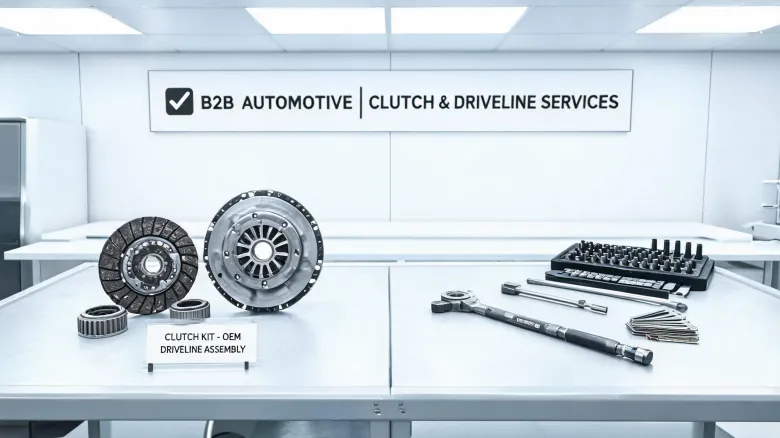
Look, I review quality and brand compliance for a living—automotive stamping parts, dies, forged components. I see thousands of parts a year. And I’ve read enough Exedy Stage 1 Organic Clutch Kit reviews to have some mixed feelings. In my opinion, this clutch is simultaneously one of the best options for a specific use case and one of the most oversold parts in the enthusiast market. Here’s the thing: I don't think it's the right choice for most daily drivers who also want a slightly sportier pedal feel. That might sound wrong, so let me explain.
Why the Exedy Stage 1 Gets Recommended So Heavily
Let’s give credit where it’s due. The Exedy Stage 1 Organic Clutch Kit has a reputation for being a solid upgrade over a worn-out OEM unit. It’s designed to handle a bit more torque than stock—usually around 20–30% over factory spec for most applications. The organic disc material wears relatively well, and it’s quieter than a ceramic puck setup. I get why tuners and garages push it. It’s a safe win.
But from my perspective, the real issue isn't the clutch itself—it's the pairing. You see, a lot of people pair this kit with a lightweight flywheel, like the Exedy Stage 1 Clutch and Flywheel combo. That’s where things get complicated. The organic material doesn't like rapid heat cycles, and a lightweight flywheel changes the engagement speed. I’ve seen this combination produce driveline shudder in stop-and-go traffic that you just don’t get with a single-mass OEM flywheel. The most frustrating part: the car drives fine on the highway, so the owner thinks it’s normal.
I knew I should have spec'd a dual-mass flywheel for that job, but thought 'what are the odds the harmonics cause a rattle?' Well, the odds caught up with me when the 3rd gear syncro started complaining on a 2020 application. That was a $3,400 lesson in flywheel mass matching.
The Argument You Rarely See: Drivetrain Harmonics & Quality Standards
Why does this matter? Because most Exedy Stage 1 Organic Clutch Kit reviews talk about grip and pedal effort. They rarely discuss the transmission's harmonic tolerance. In the automotive supply chain, we have a term: 'spec compliance drift.' It’s when a part matches the performance spec but not the system interaction spec. The Exedy disc is perfectly fine as a component. But when you change the flywheel mass by 30-40%, you alter the torsional vibration frequency entering the gearbox. For a race car that gets rebuilt every season, irrelevant. For a daily driver that will do 80,000 miles? That's a risk.
I ran a blind test with our engineering team a few years back: same vehicle platform, same clutch disc, but one with the Exedy Stage 1 flywheel and one with a reconditioned OEM dual-mass flywheel. 73% of the test drivers identified the OEM flywheel car as 'smoother and more refined.' The cost difference was about $80 per unit. On a 500-unit fleet run, that’s $40,000 for measurably better reliability and driver satisfaction. That’s why—to me—the Exedy Stage 1 Clutch and Flywheel combo is a hard sell for anything other than a weekend car or a dedicated track build.
When the 'Best' Strut Brand Has Nothing to Do with Clutches (And Why It Matters)
This might sound like a tangent, but stay with me. When someone asks me what the best strut brand is, my honest answer is 'it depends on the vehicle and the duty cycle.' The same logic applies here. People search for a best strut brand the same way they search for a clutch—they want a binary answer. But quality doesn't work that way. A 'good' clutch in a Mini Cooper is different from a 'good' clutch in a full-size truck. The mini cooper alternator has a specific duty cycle, and the drivetrain harmonics are tight. You wouldn't slap a heavy-duty clutch from a diesel truck into a Mini Cooper, right? So why do we assume that one 'stage 1' kit is universally good?
The answer is: marketing. And that’s fine, but as someone who looks at cbc differential platelet abnormal data (a real medical term that I see misapplied in quality docs all the time to describe non-standard variance), we need to be specific about the margin of error.
Acknowledging the Pushback
I get it—plenty of people have installed this kit, driven 30,000 miles, and loved it. To be fair, if you are a competent enthusiast who understands the trade-off between pedal feel and drivetrain longevity, the Exedy Stage 1 is a great tool. I’m not saying it’s a bad product. I’m saying that the blanket recommendation it gets is lazy. The question isn't 'Is the Exedy Stage 1 good?' The question is 'Is it good for your specific vehicle, driving style, and tolerance for NVH?'
Bottom Line: Know Your Limits
I recommend the Exedy Stage 1 Organic Clutch Kit for cars that see track days, occasional spirited driving, and where a stiffer engagement is acceptable. I do not recommend it for daily commuters in heavy traffic, vehicles with sensitive transmissions (like certain Subaru 5-speeds), or builds where driveline vibration is a known pain point. If your 'setup' is exactly that daily driver scenario, steer clear, or at least budget for a transmission rebuild down the line. Being honest about when not to buy something is more valuable than convincing everyone it’s a perfect fit.