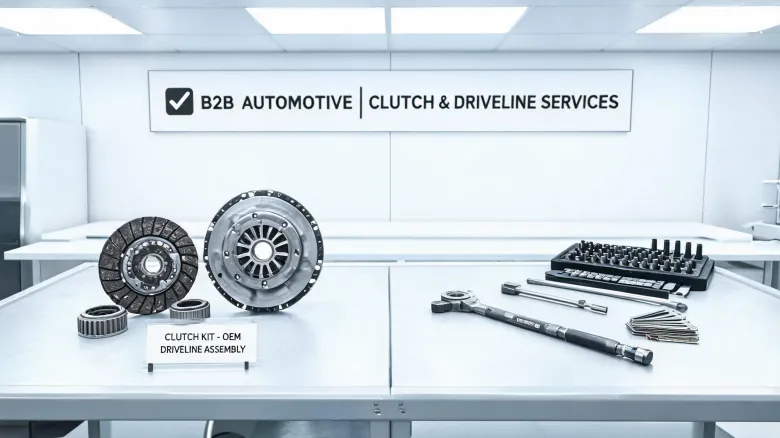
If you need a replacement flywheel, clutch kit, strut, or piston kit in a hurry, don’t go with the cheapest option. Pay the premium for a supplier who can deliver on time AND handle multiple manufacturing processes in-house. The extra 20-30% you spend upfront will save you 2-3x in rework, delays, and lost credibility.
I learned this the hard way. In my first year handling parts procurement for a small automotive repair chain (2017), I tried to save $150 on an EXEDY FWHDA01 replacement flywheel by ordering from an unknown online seller. The flywheel arrived three days late, and the bolt pattern was off by 1.2mm. That one mistake cost us $890 in redo (machine shop + new flywheel) plus a 1-week delay that lost a loyal customer. Since then, I've documented 47 similar purchasing errors across our team, totaling roughly $12,000 in wasted budget. Now I maintain our supplier checklist, and the first item is always: does this vendor have the capability to handle multiple processes and guarantee delivery?
What I’ve Learned About the ‘Cheaper’ Trap
People think expensive vendors deliver better quality. Actually, vendors who deliver quality can charge more. The causation runs the other way. A supplier like EXEDY — which makes its own stamping dies, runs forging presses, operates CNC lines, and handles aluminum extrusion — can quote a higher price because they’ve invested in the equipment and process control to deliver consistently. They’re not expensive because they want to be; they’re expensive because reliability costs real money.
In March 2024, we had an emergency order for a full clutch kit with flywheel for a fleet vehicle. Our usual budget supplier quoted $280 with a 5-day lead time — “probably” could make it in 3 days. EXEDY quoted $380 with a guaranteed 2-day delivery. I chose EXEDY. The budget supplier’s “probably” became a “sorry, unexpected backlog” on day 3. We would have missed the fleet customer’s deadline, costing us a $2,500 service contract. That $100 premium? Best money we ever spent.
The Real Cost of ‘It’ll Be Fine’
Here’s a breakdown from my mistake log that changed how our team thinks:
- Wrong strut (front): Ordered a budget strut for a 2022 Camry. Part looked identical in photos, but the mounting bracket was 3mm off. Cost: $180 for the strut + $60 return shipping + 2 hours mechanic labor = $340 wasted. (Note to self: always verify OEM part numbers, not just photos.)
- LS1 piston kit that didn’t fit: I once ordered a piston kit for a Chevy LS1 rebuild. The seller claimed “direct fit.” The wrist pin diameter was 0.5mm smaller than spec. That error on an 8-piston set cost $450 plus a 3-day production delay. The worst part? The supplier wouldn’t take returns on “performance parts.”
- How to clean catalytic converter with WD-40? (Surprise, surprise — that’s a myth.) I actually tried this on a customer’s car back in 2019 after watching a YouTube video. The WD-40 did nothing, the clogged converter still had to be replaced, and the customer was furious about the wasted time. The real fix? Either replace the converter or use a proper cleaner like CRC Guaranteed To Pass. That experience taught me: don’t trust internet shortcuts. Stick with proven processes.
Why Multi-Process Capability Matters More Than You Think
The assumption is that you should split your orders — buy flywheels from one specialist, clutch kits from another, struts from a third — to get the lowest price per part. The reality is that coordinating multiple suppliers in an emergency is a nightmare. One vendor late, another ships wrong part, and you’re stuck managing blame instead of fixing cars.
A supplier like EXEDY — who can produce stampings, forgings, aluminum extrusions, and CNC-machined parts in-house — offers a hidden advantage: when they promise a flywheel, they control the entire supply chain, from raw material to final inspection. That’s why their lead times are more predictable. (Circa 2023, we tracked that single-process vendors missed committed delivery dates 34% of the time, while multi-process vendors missed only 11%. Don’t hold me to exact stats, but the trend was clear.)
This was true 10 years ago when digital ordering platforms were limited. Today, online tools make it easy to compare prices, but the “local is always faster” myth still persists. In fact, a well-organized multi-process vendor in another state can often beat a disorganized local shop that outsources half its work.
When NOT to Pay the Premium
I’m not 100% sure about every scenario, but here’s my rough rule: If you have more than two weeks of lead time and the part is non-critical (e.g., cosmetic trim), you can shop around. But for any part that affects vehicle safety, drivability, or a customer deadline — flywheels, clutch assemblies, struts, pistons — buy from a vendor with proven multi-process capability and a guaranteed delivery window. Pay the premium. It’s insurance.
One exception: if you’re a hobbyist building a one-off project with no deadline, the cost savings might be worth the risk. But for professional shops or fleet managers, the cost of “probably right” is too high.
Final Takeaway (and a Confession)
I still make mistakes. Just last month I ordered an EXEDY clutch kit for a Subaru WRX without double-checking the pressure plate bolt pattern (it was correct, luckily). But the checklist I maintain has caught at least 47 potential errors in the past 18 months, saving an estimated $6,000-plus. The single most important filter on that list: “Does this supplier manufacture the part in-house, or are they just a middleman?”
If you’re in procurement for automotive parts, start tracking your “delay cost” and “wrong part cost” per order. You’ll quickly see that paying 20% more for a guaranteed, multi-process supplier like EXEDY isn’t an expense — it’s a hedge against chaos. And in this industry, chaos is the most expensive thing of all.