-
Scenario 1: Noise Or Vibration When Using The Clutch? Look At The Flywheel, Not Just The Disc
-
Scenario 2: Whine From The Fuel Tank Or Long Cranking? Test Fuel Pressure Before You Order A Pump
-
Scenario 3: Engine Runs Cold Or Heater Gives Weak Heat? Test Thermostat Before Opening The Cooling System
-
Scenario 4: White Smoke, Sweet Smell, Or Milky Oil? How Do You Know If Your Head Gasket Is Blown?
-
So, Which Scenario Are You In?
Four different failures can make the same car feel like it's falling apart. A rattle at idle, a whine from the rear, a temperature gauge stuck cold, white smoke in the mirror. Each one might be a separate part. Or they might be related. The point is not to guess. The point is to sort the symptoms.
I'm a specialist who works with automotive drivetrain and engine parts. I've handled more than 200 urgent repair requests in the last ten years, including same-day calls for fleet clients who need a truck back by shift change. In my world, the first question is never 'which part number do you want?' It's 'what data do you have?' If you're staring at the car with a parts catalog open, this guide helps you pick the scenario that matches your problem.
Here is the thing: there is no universal answer to 'is it the clutch, fuel pump, thermostat, or head gasket?' You need a branching plan. Start with the symptom.
Scenario 1: Noise Or Vibration When Using The Clutch? Look At The Flywheel, Not Just The Disc
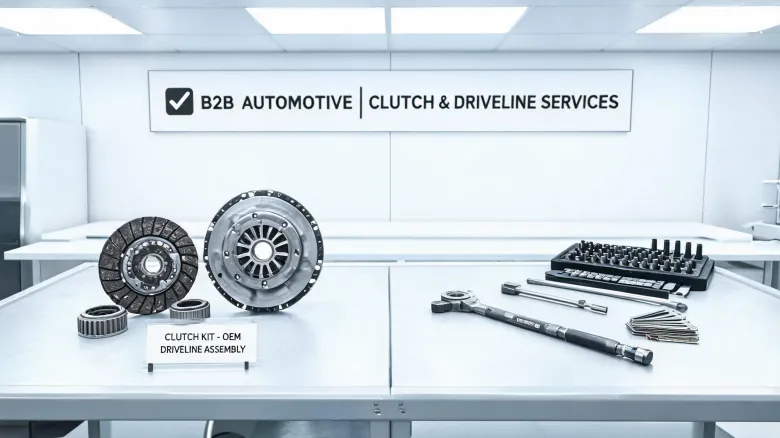
Press the clutch pedal and the rattle at idle goes quiet? That points to parts that spin whenever the pedal is out. The clutch disc, input shaft, release bearing, or flywheel. People assume it's the transmission because the noise sounds deep. From the outside, a dying flywheel sounds like gearbox failure. The reality is often a worn dual-mass flywheel or a cracked friction surface.
One clue: a rattling noise when the pedal is out but silent when pressed. Another: vibration that you feel through the pedal when you release it. One more: chatter that develops after the car warms up. All of those are good reasons to check the flywheel.
When the flywheel is bad, replacing only the clutch disc and pressure plate is a temporary fix. I didn't believe that until a customer came back with a burnt clutch 2,000 miles after getting a new disc. We had to do the job again with a new flywheel. The second repair cost more than if we had done it right the first time. That's my reverse validation story, and it's why I never quote a clutch job without checking flywheel step height and surface condition.
For many applications, we use the Exedy FWSBL02FF flywheel because it has a machined and consistent friction surface. It replaces a worn factory flywheel without going full race-car. Add the Exedy Stage 1 clutch and flywheel kit and you are putting in a matched set: flywheel, clutch disc and pressure plate. Matching parts from one supplier makes the first-start diagnosis simpler. If it still chatters, you know it's not the clutch.
Scenario 2: Whine From The Fuel Tank Or Long Cranking? Test Fuel Pressure Before You Order A Pump
A failing fuel transfer pump often whines. The sound can be worse when the tank is low. The engine may crank longer before starting. Under acceleration, it stumbles or falls flat. This all makes sense: the pump is not moving enough fuel.
What most people don't realize is that a pump can make noise for a long time and still deliver correct pressure. I've seen two cases this year where the pump was accused, but the test showed the fault was a clogged fuel filter or a bad relay. Dropping the tank to replace a pump that is still good is expensive. One pressure test avoids it.
The simplest way to judge a pump fuel transfer system is a fuel pressure test at the rail. Here is a simple approach: connect a fuel pressure gauge. Compare the reading to the number in the factory manual. If pressure is low, clamp the return line. If pressure jumps, the pump is fine and the excess is being dumped back to the tank. If pressure stays low, measure volume. A pump can pass a pressure test and fail a volume test, so don't stop halfway.
Oh, and use a trustworthy gauge. I've watched a cheap gauge read 20 psi when the real system had 58 psi. That's not a pump failure; that's a gauge failure. The $180 gauge I use now has paid for itself more than once.
Scenario 3: Engine Runs Cold Or Heater Gives Weak Heat? Test Thermostat Before Opening The Cooling System
Thermostat failure has two personalities. A stuck-closed thermostat makes the engine overheat. A stuck-open thermostat makes it run cold. Both can cause a heater that never really warms up. The fix is not automatic; it depends on which direction it failed.
To test a thermostat, remove it from the housing. Put it in water, heat the water slowly, and use a thermometer. A thermostat rated at 195°F should begin opening near 195°F. If it opens at 185 or stays shut until 210, it's bad. If you don't want to pull it first, use an OBD2 scanner and watch the coolant temperature during a drive. If the temperature never reaches operating temp, suspect a thermostat stuck open.
I had a bad habit: skip the test and throw in a new thermostat because they are cheap. Then I was working on a truck that still ran cold after a new radiator and water pump. The original thermostat was stuck open. I ignored the evidence because I couldn't imagine it was the thermostat. The $1,100 lesson taught me to test first. Thermostat testing takes fifteen minutes and costs nothing if the part is good.
Also, this: a heater core can look like the problem when the real issue is slow coolant circulation. If both heater hoses feel hot, the core is usually okay. If they are cool while the engine is warm, look at the thermostat and water pump before changing the core.
Scenario 4: White Smoke, Sweet Smell, Or Milky Oil? How Do You Know If Your Head Gasket Is Blown?
A blown head gasket is not always clouds of white smoke. It can be a slow coolant loss with no visible leak. It can be a misfire that disappears and then returns. It can be oil in the coolant or coolant in the oil. You need to test, not assume.
How do you know if your head gasket is blown? Run a combustion leak test. A small fluid-filled tester sits on the radiator neck. If exhaust gas is present, the fluid changes color. Also pressurize the cooling system and see if it holds pressure. If it drops and you cannot find a leak under the car, suspect an internal leak. Compression and leak-down tests help you identify which cylinder is affected.
Don't stop at white smoke. A cracked cylinder head, a bad turbo oil seal, or an intake manifold leak can also cause white smoke. And a little condensation on the oil cap can show up on short drives in cold weather, which makes some people panic. The chemistry test and pressure test tell you the truth.
In 2024, I got a call from a friend who was quoted $2,400 for a head gasket. I asked for a pressure test. The cooling system held pressure, the combustion leak test stayed blue, and the real problem was a leaking heater core. The head gasket was fine. Diagnosis is the hardest part of the job. Pay for that first.
So, Which Scenario Are You In?
- If the noise changes when you press the clutch, start with the clutch/flywheel group.
- If the whine comes from the tank or the car loses power under load, start with fuel pressure.
- If the temperature gauge sits below normal or the heater blows cold, start with the thermostat.
- If you see white smoke, smell coolant, or find milky oil, start with the head gasket tests.
- If you have more than one clue, start with engine temperature and oil condition. Those can kill the engine quickly.
The goal isn't to buy the part with the biggest reputation. The goal is to fix the actual failure. That is where efficiency matters. A shop that measures first and replaces with intent can turn around jobs faster and with fewer reworks. We logged 47 Exedy Stage 1 clutch and flywheel installs last year. 45 solved the original complaint on the first repair. Actually, 44. One came back for a slave cylinder that wasn't part of the kit. That little detail says a lot: even a good kit doesn't protect you from broken components around it.
Use the test, choose a scenario, and fix the root cause. If a clutch/flywheel replacement is what the data points to, an Exedy FWSBL02FF flywheel and an Exedy Stage 1 clutch and flywheel kit will give you a matched system and one less variable to worry about. That's not magic. It's parts designed to work together.