-
When You Need This Checklist
-
The 7-Step Checklist
-
1. Confirm what's actually in the car, not what the system says
-
2. Verify inventory before you talk price
-
3. Ask what's NOT included before approving the price
-
4. Check the kit contents and the actual dimensions
-
5. Nail down the shipping cut-off, not just "air"
-
6. Agree on the wrong-part protocol before you order (this is the one people skip)
-
7. Have a backup route before you're in the emergency
-
1. Confirm what's actually in the car, not what the system says
- Rush-Order Mistakes I Still See
-
Bottom Line
This checklist is for the phone call nobody wants: a production line stops Friday, and you need a clutch kit on a truck by Thursday. Or a car is on the lift and the customer is asking whether the noise was a cv joint vs cv axle—and the part you ordered is wrong. In my role coordinating emergency parts sourcing for an automotive drivetrain supplier, I've handled around 200 rush orders in eight years. Maybe 180, I'd have to check the system. The failures followed a pattern. This is the checklist we walk through before approving any rush order, whether the part is an exedy clutch kit, a specific exedy clutch kit kik1004, a ls clutch kit for an engine swap, or a single headlight bulb for a car that's waiting for inspection.
When You Need This Checklist
Use this when the normal lead time isn't possible. If you have five days and the supplier promises three, you don't need rush protocol—you need a simple purchase order. This is for the 48-hour window, the wrong part already received, or the line-down situation where someone's job depends on the shipping label.
I walk through every step, but at different speeds. When I'm triaging a rush order, the first three minutes decide whether we go into rescue mode or normal mode. The steps below are in that order, for a reason.
The 7-Step Checklist
1. Confirm what's actually in the car, not what the system says
Start with the VIN, engine code, transmission code, and build date. Not the car model. Not the year range. The exact codes. Last year we got a panicked request for an exedy clutch kit kik1004 because the customer's inventory system showed that part number. The car had a transmission swap, so the original kit didn't apply. If we hadn't asked for the transmission code, the car would have stayed on the lift.
This sounds obvious, but in a rush people skip it because they assume the customer did the homework. Most of the time they didn't.
2. Verify inventory before you talk price
The first question when I'm triaging a rush order isn't "what does it cost"—it's "where is the inventory?" A supplier can list an exedy clutch kit as available, then reveal that it ships from a different warehouse with a four-day add-on. We see it every month. The "local is always faster" thinking comes from an era before overnight freight and 24/7 B2B marketplaces. Today, a well-organized supplier in another state can beat a local one that doesn't answer its phone.
Get a stock confirmation in writing, including the shipping warehouse. If they can't confirm the physical location, you're not done.
3. Ask what's NOT included before approving the price
This is where transparent pricing matters. I've learned to ask "what's NOT included" before "what's the price." The vendor who lists all fees upfront—even if the total looks higher—tends to cost less in the end. I only believed that after ignoring it once and eating a 30% overrun on a rush order.
So ask: Is the quoted price for the kit only? Does it include the release bearing, pilot bearing, alignment tool, shipping, fuel surcharge, handling, brokerage? If a supplier won't put the full price in writing, treat that as a red flag. A low number at the top of the quote is still a high number by the time you add the hidden costs.
According to FTC advertising guidance (ftc.gov), claims need to be truthful and substantiated. When a supplier uses the word "guaranteed" in a rush quote, ask what exactly it covers and what happens if they miss it.
4. Check the kit contents and the actual dimensions
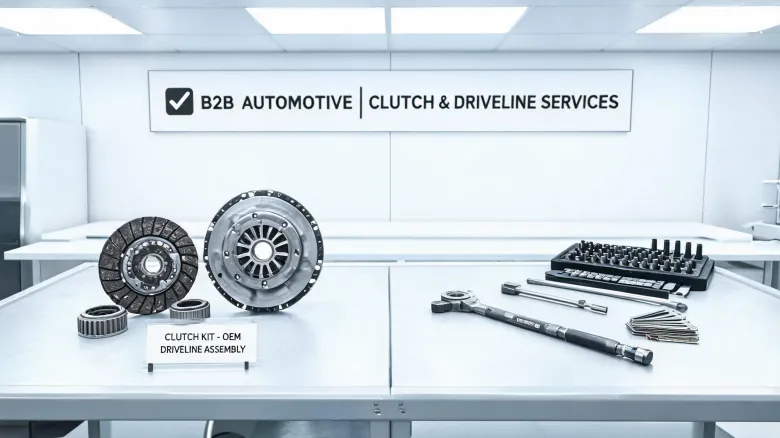
Clutch kit numbers can look identical on the outside and differ on the inside. The part number matters more than the exedy name on the box. One kit may include the pilot bearing. Another doesn't. One disc may have a different spline count. The pressure plate bolt pattern may be one generation newer than the flywheel. If you're sourcing a ls clutch kit for a swap, confirm the flywheel step height and crank flange configuration; LS swaps are famous for small differences that turn a "direct fit" into a custom fit.
I don't have hard data on industry-wide emergency mis-shipment rates, but from our own rush orders I'd estimate that one in ten has a spec error. Most come from trusting the box label instead of the dimension sheet. Take ten minutes. Check spline count, disc diameter, pressure plate height, and whether the throwout bearing is the right style.
5. Nail down the shipping cut-off, not just "air"
"It's going FedEx overnight" doesn't help if you miss the pick-up cut-off by 15 minutes. Confirm the latest time the order can be released from the supplier to the carrier. Confirm whether it's business days or calendar days. Confirm whether the quote includes Saturday delivery. This was accurate as of early 2025—supplier fee structures and shipping cutoffs change fast, so verify current schedules before you budget around them.
We paid $800 extra in rush fees once to save a $12,000 project. The alternative was a penalty clause that would have cost five times that. Overnight freight is expensive. But it's not the place to save money in a line-down situation.
6. Agree on the wrong-part protocol before you order (this is the one people skip)
Nobody orders a rush part thinking it might be wrong. But it happens. The part can be right in the catalog and wrong for the car. Before you pay, ask four questions:
- If it's wrong, do you restock it or is it a custom order?
- Do you cross-ship the replacement before receiving the wrong one back?
- Who pays return freight?
- Is there a restocking fee?
If the supplier says "we'll handle it" without specifics, that's not an answer. Get it in the quote. For production parts, this is also the moment to confirm lot traceability. Even on a rush order, IATF 16949:2016 expectations don't disappear. You need a date code and a lot trace if something fails later.
7. Have a backup route before you're in the emergency
Our company lost a significant contract in 2023 because we tried to save money on standard shipping for a critical part. The delay triggered a penalty, and the relationship never recovered. That's when we implemented a 48-hour buffer policy. Every supplier on our emergency list now has a secondary source approved in advance.
If you're calling someone for the first time while a line is down, you're already behind. Build the backup relationship before you need it.
Rush-Order Mistakes I Still See
Photos don't count as specifications
A customer once sent a photo of a worn clutch disc and said, "send the same one." You can't read a spline count from a photo. You can't tell if the pressure plate diaphragm fingers are the correct height. The photo is a clue, not a spec.
Superseded part numbers are landmines
Manufacturers change part numbers. The exedy clutch kit kik1004 may have a superseded version by now, or it may replace an older part number. The point stands: if you order by memory instead of the current catalog, you may get a box that looks right with the wrong release bearing. Oh, and confirm the alignment tool is included—it's a detail everyone forgets until the tech is halfway under the car.
CV joint vs CV axle is not just a wording problem
The cv joint vs cv axle confusion causes emergency orders every week. A CV joint is a flexible connector at the end of the drive shaft. The CV axle is the complete shaft assembly with joints on both ends. If the boot is torn but the shaft is okay, you may only need a joint. If the joint is worn and the shaft is damaged, you need the axle assembly. Ordering the wrong one almost always results in ordering a second part and paying shipping twice.
Don't assume "same brand" fits every generation
A component that fits a 2022 model may not fit a 2023, even if the connector or mounting pattern looks identical. This isn't just about clutch kits. We had a separate request for a kia niro headlight bulb once; the customer's search showed a bulb for a different model year, and the connector was slightly different. The same logic applies to drivetrain parts. Verify the year, the engine code, and the production date.
Bottom Line
The rush order that fails tends to fail for a boring reason: missed code, incomplete kit, hidden fee, or no backup plan. The fix isn't a faster call or a more expensive carrier. It's a checklist that looks at the same things every time. At least, that's been my experience with deadline-critical drivetrain orders. I do not claim this list catches every surprise—because if it did, it wouldn't be a surprise. But it catches the common ones, and that's what saves the schedule.