-
The short version: price is a starting point, not a conclusion
-
Why I'm the person saying this
-
Ball joints: where a cheap quote hides an expensive gap
-
Clutch kits: complete matters more than cheap
-
Faulty starter motor symptoms, flywheel causes
-
The catalytic converter: why the purpose matters to your wallet
-
Three questions that separate cheap from cost-effective
-
Where the value-over-price argument ends
The short version: price is a starting point, not a conclusion
A $200 saving at purchasing can turn into a $1,500 problem at final assembly. Over four years of checking automotive parts before they ship to customers, roughly 200 part numbers per year, I've watched this pattern repeat. The lowest quote ended up being the most expensive option in about 60% of the cases I've tracked.
The reason is boring and reliable: a price quote only tells you what you pay upfront. It doesn't include schedule delays, rejected batches, rework, early failures, or the diagnostic time spent figuring out why the car is acting up. Those costs are real, and they usually land on the purchasing side, not the vendor's side. Price matters. Total cost matters more.
Here's how I learned that distinction, including the times I was the one who needed the lesson.
Why I'm the person saying this
I'm the quality and brand compliance manager at EXEDY, an automotive supplier that manufactures stamping dies, forged components, aluminum extrusions, CNC machined parts, and clutch systems. Because we build tooling in-house, we can't point fingers at a supplier when a part misses tolerance. The responsibility sits with our own shop.
My job is simple to describe: review every deliverable before it reaches customers and reject anything that doesn't meet specification. In Q1 2024 alone, I rejected 18% of first deliveries from new sources. Not because the parts looked broken, but because the material traceability or the dimensional reports didn't match the contract. In this role, consistency isn't a preference. It's the job. Period.
Ball joints: where a cheap quote hides an expensive gap
Take a ball joint in car suspension. It connects the control arm to the steering knuckle, carries the vehicle's weight, and absorbs the impact of every pothole. The tapered stud that seats into the knuckle has to hold under shear load, in cold weather, for years. That's not a premium feature. It's the part's reason to exist.
A new supplier quoted 12% below our existing source. The commercial team liked the price. When I reviewed the material certificate, the low-temperature impact test data was missing. I flagged it. The vendor's response: "It's within industry standard."
Look, that might be true. But our specification asks for specific data, and "industry standard" isn't a document you can audit. I asked for the actual test results. That's when the real problem surfaced.
We had said "we need full material traceability." They heard "send us your ISO certificate." Same words, different levels of rigor. The certificate they sent covered a different heat of material than the production batch. We discovered this with 8,000 units already in storage, waiting for the paperwork to match the product. Those units didn't ship. The batch went back, the supplier re-manufactured at their own cost, and we still lost three weeks of schedule.
The 12% price advantage disappeared into what it actually cost to fix the problem. That's the hidden cost that never appears in a quotation.
Clutch kits: complete matters more than cheap
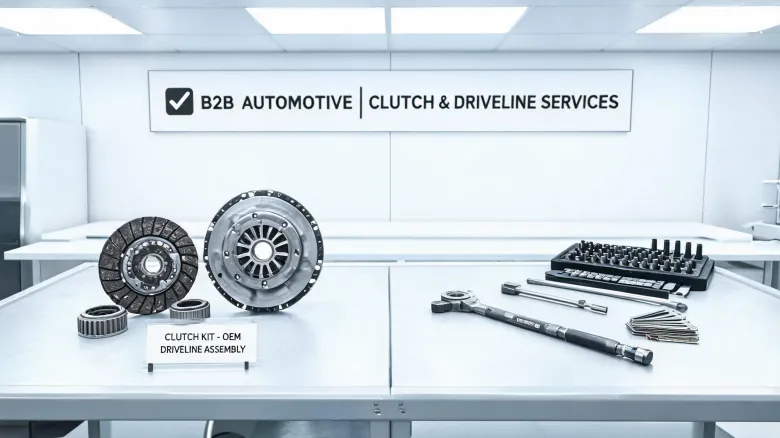
The EXEDY OEM replacement clutch kit includes a cover assembly, a driven disc, and a release bearing, all matched and validated as a system. Clamping load, friction material behavior, and bearing travel are designed together and tested together. That's what "kit" means around here.
Cheaper kits often mix components from different sources. The invoice is a few hundred dollars smaller, sure. But engagement behavior, pedal feel, and service life all become harder to predict. And unpredictability in a drivetrain part gets expensive fast. A clutch that fails at 20,000 miles costs labor twice—plus the customer's lost vehicle time.
Here's a nuance most buying guides skip: a stage 2 clutch is not an upgrade in the universal sense. An EXEDY stage 2 clutch and flywheel is designed for higher torque capacity. It has a firmer pedal and a more abrupt engagement. If the vehicle isn't built to use that extra capacity, you're paying extra to make a daily driver harder to drive smoothly. That mistake has a nickname in our office: "the upgrade that wasn't."
When we reviewed audit data a while back, choosing the right spec for the application improved customer satisfaction scores by 34%. I recall the sample included around 80 vehicles, though I might be off on the exact count. The direction was clear even if the exact decimal isn't.
Faulty starter motor symptoms, flywheel causes
Search for "faulty starter motor symptoms" and you'll get a list: clicking noise, slow cranking, whirring, or silence when you turn the key. All accurate. But I'd estimate a solid quarter of the starter complaints we investigate trace back to the flywheel ring gear, not the starter motor.
The ring gear is the toothed wheel around the flywheel. Every time the starter engages, its pinion drives those teeth. If the gear teeth are too soft, too hard, or damaged, the starter interacts badly, and the symptoms are indistinguishable from a starter motor failure.
We once accepted a batch of rebuilt flywheels from a supplier we'd used for three years. The protocol required a hardness check on ring gear teeth for each new production lot. I skipped it. We were behind schedule, the supplier had never failed us, and I told myself "what are the odds?"
The odds were one in one. A technician flagged soft teeth on three flywheels in a 40-piece sample at final assembly. That quality issue cost us $22,000 in rework and delayed a customer launch by three weeks. The exact scenario our verification protocol was designed to prevent—and I had chosen to treat the protocol as optional.
If I could redo that decision, I'd wait for the hardness report. But with the deadline pressing and the supplier's track record clean, I made the call with incomplete information. The invoice for what I didn't know arrived within the month.
The catalytic converter: why the purpose matters to your wallet
If you're here because you're asking "what is the purpose of the catalytic converter?", the short answer is that it converts the three main toxic compounds in engine exhaust—carbon monoxide, nitrogen oxides, and unburned hydrocarbons—into less harmful carbon dioxide, nitrogen, and water vapor. It's a chemical reactor in the exhaust line, using a ceramic or metallic substrate coated with precious metals to trigger reactions at high temperature.
That function is exactly why cheap converters are a poor trade. Substrate density, precious metal load, and washcoat quality determine how long the converter keeps working. A budget unit can pass a bench test when new. After months of thermal cycling, I've seen substrate material crack or melt in under 15,000 miles.
Once that happens, the downstream oxygen sensor reads wrong, the ECU compensates by enriching the fuel mixture, and the engine starts running rich. Rough idle, poor fuel economy, misfires. The $120 saved upfront becomes $300 in diagnostic time and another $180 for an oxygen sensor that wasn't actually broken. You end up paying for quality anyway—just in a messier way.
Three questions that separate cheap from cost-effective
When I formalized our verification protocol in 2022, I wrote three questions that every new source and every new part number must answer:
- Do you provide full material traceability?
- Which tests are run on the actual production lot?
- What happens when a part lands at the edge of tolerance?
The vendors who answer these cleanly are rarely the cheapest on paper—and rarely the most expensive in practice. Our incoming first-pass acceptance rate went from 74% in 2021 to 92% in 2023. The cost of asking questions was zero. The value of the answers showed up in the acceptance rate.
I'll confess how I learned this works: I only believed in the three-question list after ignoring it once. Midway through an $18,000 sourced-component project, I accepted a verbal assurance from a new supplier without sending the full checklist. The first delivery arrived with no material certificates for half the batch. We either shipped it back and lost three weeks, or paid for independent testing at $4,500 and lost two. I paid for the testing.
Now every contract we issue includes traceability, production-lot testing, and edge-of-tolerance language. It costs nothing to write, and it saves real money every time it catches a gap.
Where the value-over-price argument ends
I don't want to overstate this. Honestly, the cheapest option is the right call in about 40% of the cases I've seen. That's not a tiny exception. Non-critical cosmetic parts, components that are easy to inspect, and parts with low failure consequence are all reasonable places to hold a budget line.
There are also low-cost vendors who do great work. They earn that position with process discipline and honest documentation—not by cutting corners. Price alone won't tell you which category a quote falls into. That's why the three questions matter more than the number on the quotation.
One more boundary: this is the perspective from an automotive quality role in the supply chain. At least, that's been my experience over the past four years. Different industries and different part families shift details. The core stays the same: total cost is a better question than unit price.
So buy the cheapest part if the three questions get honest answers. Sign the PO. Sleep well. But if a vendor can't answer them, that quote was never cheap. It just hadn't finished costing you yet.