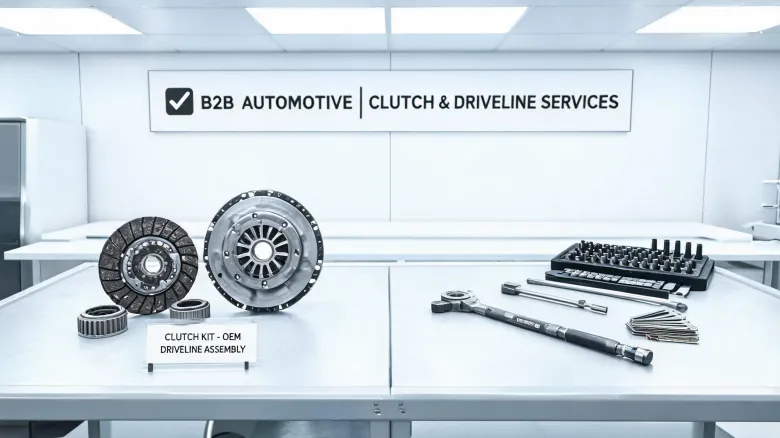
It started with a phone call on a cold Tuesday in March. A distributor in Ohio had a repair shop claiming the Exedy OE clutch kit for Honda Civic (1992-2000) was defective. Chatter on engagement, the shop said. Less than 1,500 miles on the install.
I'm a quality manager at Exedy. I review every part release before it reaches customers—over 200 unique part numbers a year. In Q1 2024 alone, I rejected 6% of first deliveries because specs didn't match the print. I know what our parts look like when they're right. So when a clutch kit comes back "defective," I don't argue. I take it apart.
The Kit Checked Out
Clutch kits are simple in concept but unforgiving in execution. Here's the inspection I run on every one before it ships. First, confirm the part number on the box matches the application list for the engine code on the timing belt cover. Second, check the pressure plate fingers—uneven finger height translates directly into grabby engagement. Third, measure the disc lining thickness at three points around the disc. Fourth, spin the release bearing; it should feel smooth, not gritty. All four checks take about eight minutes.
This kit passed all four. The part number matched the D16Y7 application for the 1998 Civic. Disc thickness was in spec. Lining wear looked even. Fingers sat at the same height. The release bearing spun clean.
Nothing about the kit was wrong.
So I asked the shop what they did to the flywheel before install.
Silence. Then: "We didn't touch it. It looked fine."
That's what I expected. That's probably the most common cause of clutch chatter we see: not a defective clutch kit, but a flywheel that was never prepared. The kit wasn't the problem. The preparation was.
Why do I go straight to the flywheel? Because I skipped that step once, and it cost us a $22,000 mistake.
Back in 2021, I approved a similar clutch job without putting "resurface or replace flywheel" into the work order. The shop didn't do it. A week after install, the customer was back with chatter so bad the dash rattled. We covered a new flywheel, new labor, and a rental car. That failure is why I implemented our verification protocol in 2022. Now every clutch job that goes out under our name has the mating surface documented, not just the part.
Here's the core lesson: the clutch kit is one half of the system. The flywheel surface is the other half. You can inspect a part a hundred times and still miss the condition of the surface it bolts to.
The Leaking Strut That Wasn't Our Problem
While the car was on the lift, the shop owner pointed at the passenger side. The strut was leaking—an oily streak running down from the seal. He asked if we made suspension parts too.
No. And I'm not going to pretend we do.
A leaking strut means the seal is gone, and the only real fix is replacement. But that's a suspension specialist's job, not mine. I know the shape of the problem; I don't know their valve curves, and I don't need to. I told him we were the wrong people to quote that repair, and I gave him the name of a shop that does suspension work every day.
He looked surprised. Then he said something I still hear clearly: "You're the first supplier who's said that."
I've had that reaction before. Over the last four years, I've learned to trust suppliers who admit their limits. A vendor who told me in 2021, "this isn't our strength—here's who does it better," earned my business for everything else. I'd rather work with a specialist who knows their boundaries than a generalist who overpromises. That applies to my own company too.
Master Cylinder, Fuel Pump, and Other Questions
The shop owner had more questions while we finished the inspection. Did the Civic need an Exedy master cylinder while the transmission was out?
Short answer: no. This generation Civic uses a cable-actuated clutch. There's no hydraulic master cylinder in the system. The pedal moves a cable that operates the clutch fork directly—in most variants, anyway. If you're working on a hydraulic-clutch version, the master cylinder sits on the firewall, and it's absolutely worth inspecting while the car is apart.
For vehicles with hydraulic clutches, the Exedy master cylinder and its matching slave cylinder are separate components from the clutch kit itself. Both deserve a look during any clutch job. But on a 1992-2000 Civic with a D-series engine, the cable setup means there's nothing to bleed and no master cylinder to replace.
Then he asked a completely different question: how does a mechanical fuel pump work? His old pickup had a carbureted engine, and he'd never understood the pump.
That I can explain in plain terms. A mechanical fuel pump is driven by an eccentric lobe on the camshaft. The lobe pushes a rocker arm, which pushes a diaphragm down inside the pump. That downward stroke pulls fuel from the tank through an inlet check valve. When the lobe rotates past, a spring pushes the diaphragm back up, forcing fuel out to the carburetor through an outlet check valve. Rinse and repeat. Two check valves, one diaphragm, one camshaft lobe. That's it.
If the pump won't prime or leaks, the usual suspects are the diaphragm and the check valves, not the pump body. But honestly, I couldn't tell him the exact pressure spec for his specific truck. Every application has its own number. I told him to check the service manual and verify before replacing anything. Don't hold me to a universal spec—that's how bad advice starts.
Electric Trailer Brakes: Staying in My Lane
Then he asked about an electric trailer brake kit for his work truck. Not our lane.
Brake controllers, proportional versus time-delayed actuation, tow wiring harnesses—I know these exist, but I don't live there. I told him the same thing I tell every customer when something falls outside our capability: find a shop that does trailer wiring as their main job. We don't do it halfway.
That honesty isn't a loss. It's how trust compounds.
What It Cost, and What It Taught Me
Here's how this one ended. We had the shop pull the transmission and measure the flywheel. They found it scored, with glaze from the old disc. No new clutch could have bedded in on that surface. We approved the resurface, they reinstalled the kit, and the customer followed the break-in procedure. A month later, no chatter. The part was never the problem.
Three things from this job, in the order I learned them:
- The part number is not the final word. Verify the application, but also verify the surface the part mates to. Flywheel, pilot bearing, input shaft splines. A perfect part on a bad surface fails exactly like a bad part.
- A leaking strut is a leaking strut. It's a separate trade. Say so.
- If you don't know something, say you don't know. I couldn't quote a fuel pump spec from memory, so I gave the general principle and pointed to the manual. The customer got a better answer than a confident guess.
One more thing about claims. Per FTC guidelines (ftc.gov), marketing claims have to be truthful and substantiated. That's why you'll never hear me say "guaranteed zero defects." It's not a defensible sentence. What I can tell you is what we actually verify: prints, material certificates, part numbers, application lists, and mating surfaces. That's the promise that holds.
And a final practical note. This is accurate as of January 2025. The application data I used for the 1992-2000 Civic comes from Q4 2024. Part numbers get superseded, and prices change—the USPS first-class letter rate is $0.73 as of January 2025 (verify it at usps.com), and quoting last year's rate would make me wrong. Same with catalogs. Don't order from last year's screen.
Verify the current part number. Then verify the surface. That's the job. The whole job, really. Verify.