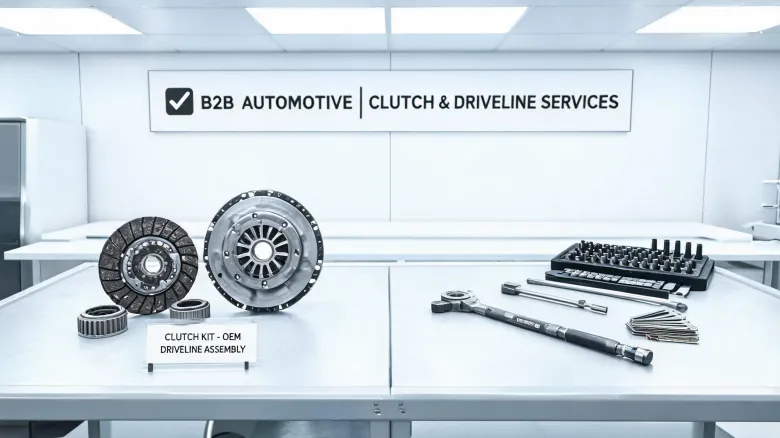
-
1. Is an Exedy clutch kit the right choice for a daily driver?
-
2. What should I know before buying the Exedy FWHDA01 replacement flywheel?
-
3. How do I know if my Subaru Legacy has a head gasket problem?
-
4. Is the Hitachi IGC0084 ignition coil a direct replacement?
-
5. Can you jump start a car with a bad alternator?
-
6. What should I prioritize when a repair has to happen today?
I coordinate emergency parts for an automotive supplier, so I spend a lot of time on the phone with repair shops that have a car on the lift and a deadline that's closer than it looks. This article answers the six questions I hear most: Exedy clutch kits, the Exedy FWHDA01 replacement flywheel, Subaru Legacy head gasket failures, Hitachi IGC0084 ignition coils, and the old 'can you jump start a car with a bad alternator' question.
Here's what we'll cover:
- Is an Exedy clutch kit worth it for a daily driver?
- What do I need to know about the FWHDA01 flywheel?
- How do I spot a Subaru Legacy head gasket problem?
- Is the Hitachi IGC0084 ignition coil a direct replacement?
- Can you jump start a car with a bad alternator?
- What should you do when the repair has to happen today?
1. Is an Exedy clutch kit the right choice for a daily driver?
For most stock and lightly modified Japanese cars, yes. Exedy is one of the OE clutch suppliers for Japanese automakers, so you're often buying the same type of clutch that came from the factory. But 'Exedy clutch kit' is not a single product. If your car is stock and you want a normal pedal and decent lifespan, the OE-style kit is the right lane. If you've added a turbo, a cam, or 50 horsepower over stock, you need to look at an uprated kit.
I've seen someone put the stock kit on a modified car because it was cheap. It slipped on the third pull. To be fair, that's what the catalog indicated for the car. The kit wasn't defective; the spec was wrong for the build. If you're not sure what you need, call with your VIN and current modifications.
2. What should I know before buying the Exedy FWHDA01 replacement flywheel?
The FWHDA01 is an OE-style replacement flywheel, not a lightweight race part. That matters if you're expecting a quicker-revving feel. The reason people replace it is usually because the original flywheel is scored, heat-checked, or cracked, and resurfacing isn't an option. If the catalog lists FWHDA01 for your engine and transmission code, it's a practical replacement.
One caution: verify the transmission code, not just the engine. In 2024, a shop called us with a car on the lift. They ordered a flywheel based on the engine only and it didn't match the transmission. Looking back, they should have checked the code before hitting buy. I still kick myself for not making transmission codes a mandatory field on our order forms. Now our policy is to double-check transmission codes on any flywheel order. If you're in a hurry, that 2-minute check can save you a week.
3. How do I know if my Subaru Legacy has a head gasket problem?
The usual signs are coolant loss without a visible puddle, milky oil, bubbles in the coolant overflow, or a misfire that keeps coming back. The EJ25 engine in many Legacy models also develops external head gasket leaks before it starts overheating. If it's just a seep and the engine runs cool, you have time to plan the repair. If it's overheating, don't drive it. A warped head is a lot more expensive than a tow.
Per the Subaru factory service manual, the head surface has to be checked for flatness before reinstalling. I've seen a head gasket job turn from a straight swap into a machine shop job because the head was warped. The price difference was roughly $700. I'm not 100% sure how much machine work costs at your local shop, but as of early 2025, we were seeing Legacy head gasket repair estimates in the $1,500 to $2,800 range where I work, before machine work and taxes. Your area may be different.
4. Is the Hitachi IGC0084 ignition coil a direct replacement?
Usually, yes. Hitachi was an OE ignition coil supplier for Japanese vehicles, and IGC0084 is their replacement part number. If your VIN matches the application, it should be a direct fit. The common symptoms of a bad coil are a rough idle, a flashing check engine light, a misfire under load, and sometimes a fuel smell because the injector is firing but the coil isn't.
The question shops ask me is: replace one coil or all of them? I get why people try to save money by replacing only the failed coil. But if the others have 120,000 miles on them, you're likely to be back next month. If you can swing it, do the set. And avoid mystery-brand coils with no traceability. A dead coil in two weeks costs you more in labor than you saved on the part.
5. Can you jump start a car with a bad alternator?
Yes, you can jump-start it if the battery is flat. But the alternator's job is to keep the battery charged while the engine runs. If the alternator is dead, the car is running on battery reserve, and that doesn't last long. We tested this in the shop once: with a fully charged battery and all accessories off, it ran about 20 minutes (which, honestly, was longer than I expected) before the electronics started doing strange things. With lights, wipers, and the blower on, it was much less.
One thing I'll tell you not to do: disconnect the battery while the engine is running to check if the alternator is working. On modern cars, that can cause a voltage spike that damages the ECM. It's an old trick that doesn't belong in 2025. A jump start with a bad alternator is a one-time emergency move, not a plan. Get the alternator fixed before you get stranded.
6. What should I prioritize when a repair has to happen today?
Time, fitment, and consequence, in that order. In my role triaging rush orders, the biggest mistake I see is people fixating on price and ignoring whether the part actually fits. Last quarter, a shop was in a hurry and grabbed a clutch kit from a discount listing because the delivery date worked. The part name matched, but the transmission code didn't. The job stopped two days later, and they ended up paying for an overnight Exedy kit and extra labor.
If you're buying a part today, bring your VIN and any codes you can find. That works for me because I deal with shops and suppliers on a daily basis. If you're at home doing the work yourself, the same logic applies; you just have more time to catch a wrong part before the old one is already off the car.
Honestly, most rush failures are not bad parts. They're missing details. A quick double-check is cheaper than a comeback.