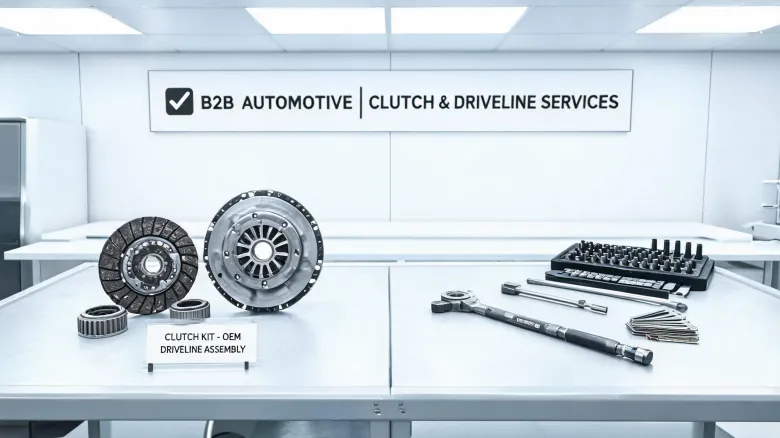
Thursday, 3:17 p.m. A purchasing manager calls and asks for an Exedy clutch kit price with overnight delivery. The transmission is already out of the car. The production line is stopped. The customer is standing next to a truck that should have left two hours ago.
I work on the emergency-response side at Exedy. Over the past eleven years, I have coordinated more than 200 rush orders for OEMs, Tier 1 suppliers, repair shops, and fleet maintenance teams. That has been enough to teach me a simple lesson: the urgent part order is rarely the root cause. It is usually the second failure.
The surface problem: a missed deadline
When someone calls us for a part that has to be there in the morning, they think the problem is logistics. Get the box to the shop by 6 a.m. and the emergency is over. Sometimes that is true. But I have watched the same customer call back four weeks later with the same symptom, the same confusion, and a bigger invoice. The delivery was fine. The diagnosis was not.
The deeper problem: nobody checked the system
Most urgent orders follow a recognizable sequence. A part fails earlier than expected. Someone orders a replacement at the lowest possible price. Nobody asks why the original failed. When the next failure occurs, it is harder, more expensive, and more urgent.
It does not matter whether the emergency involves a clutch assembly, a stamped metal part, a master cylinder, or a die that should have been pulled from the press a month ago. The pattern is the same: a component was treated as if it existed in isolation. It does not.
1. Diagnosis skipped over the system
A good example is the 2003 F-150 catalytic converter. I took a call about one that kept failing. The shop wanted a new converter—the second one in six months. When I asked if anyone had checked the ignition system, the silence was enough of an answer. The underlying problem was a weak coil and spark plug resistance that had drifted outside specification. Raw fuel from the misfire was entering the exhaust and overheating the converter substrate. No replacement converter was going to survive that.
Clutch systems behave the same way. A soft pedal or hard engagement may come from the pressure plate, the release bearing, the flywheel face, or the hydraulic circuit. If a shop replaces the entire clutch kit without checking those variables, a perfectly good Exedy clutch kit can fail early and take the blame for an isolated mistake.
Suppose the diagnosis points to the hydraulics. In that case, an Exedy clutch master cylinder might be the correct component—but only after you measure line pressure, inspect the slave cylinder, and flush the old fluid. Otherwise, you are treating a symptom and creating another emergency for later.
2. Price becomes the only specification
I understand why so many buyers start with an Exedy clutch kit price query. Price is the easiest number to compare. It is also the least complete number on the page.
In March 2024, a customer saved $45 by using a cover from an unverified source. Two weeks later, their production line stopped because the cover did not match the release load specification. The shutdown cost them more than $6,000 when freight, overtime, and a delivery penalty were added. They called us for the emergency replacement. The $45 saving had financed a much larger loss.
To be fair, the correct part is not always the most expensive one. Sometimes a smaller supplier has the right part and the right test data. But if the supplier cannot show batch traceability, application testing, and engineering support, then the lowest quote is not a good deal. It is an unverified risk that will be charged to your reputation if it fails.
3. Maintenance gets treated as an optional expense
Deferred maintenance is one of the most predictable causes of emergency orders. It starts with a $3 seal that looked fine, a fluid specification that someone swapped to save a few cents, or a filter that everyone intended to change but did not schedule.
I hear versions of this every month: 'How often should you replace cabin air filter?' The short answer is in the owner's manual, usually every 12,000 to 15,000 miles or once a year. But the deeper issue is not the specific interval. It is the mindset that maintenance is an expense that can wait. Skipping maintenance does not remove the cost. It just converts it into an urgent expense, usually with interest.
Cabin air filters do not stop production lines. But the discipline that changes them on schedule is the same discipline that catches a worn clutch release bearing before it turns into a complete clutch replacement.
4. The 'local is always faster' belief
The 'local is faster' thinking comes from an era when supply chains had fewer options and the warehouse around the corner was the only realistic source for a next-day part. That changed. Modern logistics means a qualified supplier two time zones away can often beat a local supplier with no inventory and no traceability. The limitation is no longer distance. It is accurate information, available stock, and component verification. You can have a warehouse next door and still fail if nobody knows which part version is actually in the machine.
What an emergency actually costs
An emergency order has an obvious price tag: expedited freight, overtime labor, downtime, and sometimes a penalty clause. But there is a larger cost that does not appear on the first invoice. It is the impression you leave with your customer. When a part fails, they do not remember that you saved $40 at purchase time. They remember that you caused their truck to sit in the shop for three days, or that their production line missed a launch window.
That understanding changed how I work. Around 2023, a buyer chose a valve body based on the lowest quote. It was not an Exedy part, but the story was the same: incorrect specification, failed installation, two freight charges, two labor charges, and one very frustrated customer. Don't hold me to the exact total—I remember the look on their face more clearly than the spreadsheet—but the waste was several times the price of the correct component. After that incident, I started telling every customer that quality is not a premium feature. For an automotive supplier, quality is the product.
The fix is not exciting
If you want to stop emergency part orders, change what you mean by fast. Fast is not a part shipped overnight. Fast is a part that was correctly specified, available when needed, and installed successfully the first time.
- Diagnose before you quote. If you do not know why the old part failed, an urgent replacement is a bet.
- Compare lifetime cost, not part price. Include labor, downtime, freight, and the probability of a second failure.
- Use scheduled maintenance windows to inspect the complete system—clutch hydraulics, ignition, exhaust, and filters.
- Qualify suppliers by their data, not just by their price. If they cannot show traceability and application support, you are carrying the risk.
None of this is glamorous. Glamour is what happens when a cheap component turns into a whiteboard full of extra costs and a missed deadline. The quiet version is a part that works the first time, every time. That is the version that builds a reputation.