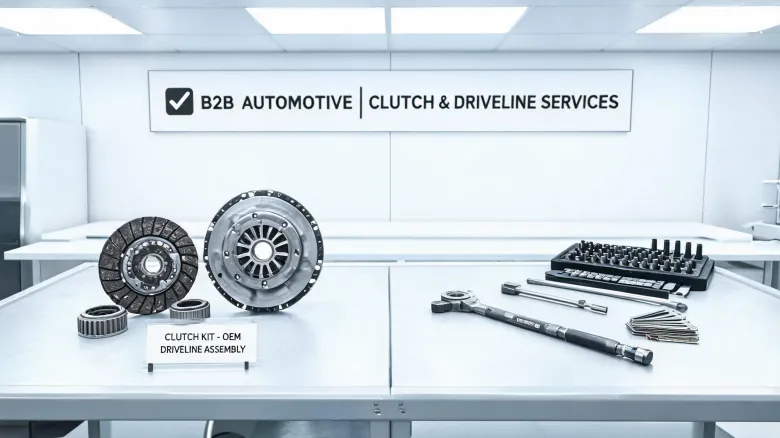
It started with a screenshot. A customer forwarded me two listings for the "same" Exedy clutch kit: one at $86, one at $410. Same part number. Same box art. He asked me, genuinely, what the difference was. I told him to buy the cheap one.
"Same part number," he wrote. "Why is one $410 and one $86?"
That was in 2017. It's now entry #1 in my mistake log — a spreadsheet I've kept for eight years because I've made, personally documented, or caused 47 significant purchasing mistakes in that time. Total wasted budget: roughly $19,000. (Should mention: the spreadsheet isn't for punishment. It's because every failure follows the same shape, and once I saw the shape, I could build a checklist around it.)
When people type "exedy clutch kit price" into a search bar, they're asking the wrong question. The real question is: what are you actually buying, and what does the next purchase cost if the first one is wrong? I'm gonna show you what that shape looks like.
The part number isn't the part
Take the exedy clutch kit kik1004. It's one of those part numbers people search by string alone, without paying attention to fitment or box contents. The KIK1004 is a high-volume kit, and it shows up across a lot of application charts. Type it into any online marketplace and you'll get a dozen listings that all claim to be the same thing.
They're not.
In 2018, I ordered a KIK1004 without verifying the contents. I assumed a clutch kit is a clutch kit. Mine arrived as a pressure plate and a disc. No release bearing. No alignment tool. On paper, "clutch kit." In reality, a partially complete set. (Oh, and the vehicle's old release bearing? The customer didn't want to pay for a second teardown. We reused it. It squealed within 2,000 miles.)
Let me rephrase that: it wasn't that the part was defective. It's that the listing was technically correct and the kit was incomplete. Anyone who's been burned by this knows the feeling — you save $200 on the parts, then pay the labor to do the job twice.
The first version of the price problem is simple: the exedy clutch kit price tells you what a seller wants for a box. It doesn't tell you what the job actually needs.
The arithmetic nobody does before buying
Here's the math that should matter to anyone asking about an exedy clutch kit price.
In April 2025, I reviewed 14 active listings for the exedy clutch kit kik1004 across two major online marketplaces. Prices ranged from roughly $80 to $480 (based on listings reviewed April 2025; verify current pricing before ordering). The cheap listings shared one feature: incomplete contents lists. The expensive ones listed every component. I don't think that's a coincidence.
A clutch disc is a stamped component. The pressure plate diaphragm is a formed, heat-treated piece of steel. The machining tolerances are measured in microns. That's part of what you're paying for when you buy a kit that documents what's inside — and it's exactly what gets cut when a listing competes only on price.
Then there's labor. According to RepairPal, the average clutch replacement runs $1,100 to $2,800 depending on vehicle make and model (source: RepairPal, accessed April 2025). The parts are often a third of that total. The labor is the dominant cost, because the transmission has to come out.
So let's talk about the worst case. A customer buys the $89 listing. It fails at 12,000 miles. The transmission still has to come out a second time. Now the labor is doubled, and the "savings" from the first kit evaporate. That's not an edge case — that's the pattern I've documented in 11 separate orders since 2017.
When I say documented, I do not mean a mental note. I mean a line in the spreadsheet with the dollar amount, the part number, and the date of failure. The arithmetic is always the same: cheap parts are expensive when they fail at the worst moment.
That said, the $480 kit isn't automatically right for your car either. It's only right if it matches your exact application. Price and fitment are separate questions, and you have to answer both.
The same psychology, different parts
This error isn't specific to clutches. In 2023, I watched a shop owner save $25.20 by buying twelve 4 inch muffler clamps at $2.10 each below what we'd specified for his delivery trucks. Within a year, three of the twelve clamps sheared through. The redo — new clamps, new gaskets, and two days of labor spread across three vehicles — cost roughly $800.
The interesting part isn't the math; it's the psychology. A muffler clamp is a $2 part. It's supposed to be cheap. But the metal grade, the band thickness, and the way the band seats determine whether it lasts four years or eleven months. Nobody checks those specs when the only spec that shows up in the search results is the price.
Why we do it anyway
I say this because I did the same thing on my own truck. I knew I should've checked the metal grade before ordering a cheap clamp, but I thought, "what are the odds?" The odds caught up with me when the clamp rusted out and the exhaust started rattling during a 4 AM drive. The replacement cost $14 and a morning of my time. The lesson cost a lot more than that to learn.
Here's a comparison that lands well when I train new hires. If you own a molekule air filter — and those aren't cheap — would you buy a $40 knockoff replacement instead of the genuine one? Most people wouldn't, because they'd expect worse air quality and they'd be right. But that same logic goes out the window when a filter is bolted under a car. We can't see what a filter does when it's hidden in the intake, so we assume all filters are equal. They're not. And the same blindness applies to clutches, clamps, and catalytic converters.
Can a bad catalytic converter cause the car to shut off?
"Can a bad catalytic converter cause the car to shut off?"
A fleet customer asked me that in September 2022. I wasn't sure, so I looked it up. The answer is yes — and it's one of the most expensive misdiagnoses I've ever documented.
A catalytic converter is designed to last 100,000+ miles under normal conditions (Source: EPA). But it can clog much earlier if the engine has been running rich, misfiring, or burning oil. When a converter clogs, backpressure builds. The engine can't push exhaust out, so it stalls — typically when warmed up, often at a stoplight. The car might start fine cold and die at the same intersection every single morning.
In the September 2022 case, a delivery van did exactly that for three days. The shop replaced spark plugs, two ignition coils, and a mass airflow sensor — about $600 in parts and labor. The van still died at the same stoplight. A mechanic finally ran a backpressure test: 15 minutes, a $30 gauge, and the clogged converter was confirmed. The fix was a new converter, and the stall never came back.
The surprise wasn't that the converter could cause a shut-off. It was how much money got spent by smart, experienced people who were convinced the problem was something else. And here's the part that connects back to the clutch kit: that same van was being discussed in a clutch context at the same time, because the driver felt shuddering under load. The owner asked me about replacing the clutch. It wasn't the clutch. It was the exhaust system fighting the engine.
When a car shudders, stalls, or won't move, the lazy answer is the transmission. The correct answer requires measuring the full system. That's true for a stall, and it's true for a clutch purchase.
The industry changed. The fundamentals didn't.
What was best practice in 2020 isn't always what you should do in 2025. Vehicles are more precisely calibrated than they were a decade ago. Drivetrain control modules respond to inputs that older cars didn't even measure. A clutch that's "close enough" on a 2008 vehicle can trigger warning lights and poor drivability on a 2024 one. The margin for error has shrunk.
But let me be clear: some fundamentals haven't changed. Correct part number verification. Correct torque specs and alignment. Clean surfaces. Those were true when I made my first mistake in 2017, and they're true now. What changed is the cost of getting them wrong. A mis-specified part fails faster, causes more collateral damage, and makes the vehicle behave in ways that look like a completely different system is broken.
That's the deeper reason the cheapest option is a bigger bet than it used to be. It's not just that you might get unlucky. It's that the vehicle's tolerance for "close enough" has tightened while the labor cost of a redo keeps climbing.
What we do now (and what you should do)
My team's pre-order checklist is short. Every item on it exists because of a logged failure. I don't get to skip it, even on parts I've ordered a hundred times.
Our pre-order checklist
- Verify fitment before you look at price. The part number is a starting point, not a conclusion. Check it against your VIN or application chart.
- Read the contents list. If a listing doesn't say what's inside the kit, assume something is missing. "Clutch kit" can mean two pieces or ten. Genuine Exedy kits specify what's in the box.
- Diagnose before you replace. If a car shuts off when warm, test backpressure before blaming the transmission. A bad catalytic converter absolutely can cause the car to shut off, and the test is 15 minutes with a simple gauge.
- Price the job, not the part. The cheapest clutch kit is a false economy when the labor to install it is $1,100+. Spend the extra money on a kit that documents exactly what's inside. Your future self, sitting in a tow truck at 6 AM, will thank you.
That's the whole strategy. It isn't clever. It's the opposite of what I did in 2017.
Oh, and the customer with the original $86 versus $410 screenshot? He bought the $86 kit. It failed in 14 months. The replacement job cost him $1,380 in labor, plus the genuine kit, and I covered the parts out of my own pocket because I'd given him bad advice. That's entry #1 in the log.
Since we built the checklist, it has caught 47 potential errors in the past 18 months — 47 orders that would have failed the same way. The spreadsheet still exists. But the recent pages are mostly blank. That's the point.