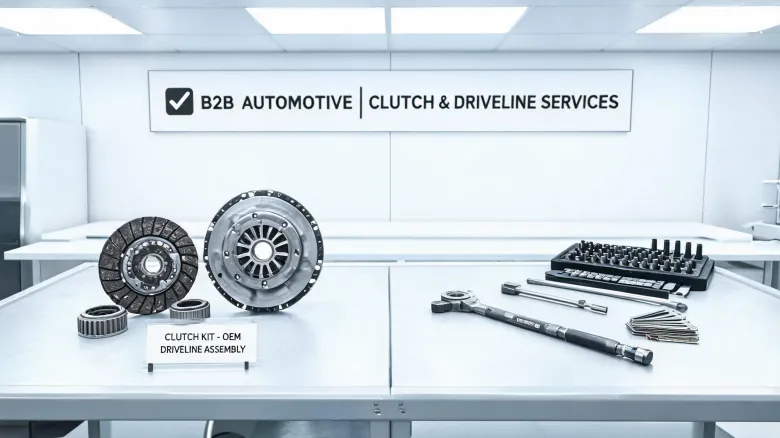
The short answer: the Exedy 05800 racing clutch kit is for tracked cars and high-horsepower builds. The Exedy clutch kit KIK1004 is the better choice for a street-driven car that still sees traffic. Pick based on how you drive, not on which one sounds cooler. And whatever you decide, spend more time verifying the kit is genuine than you did picking it, because counterfeits under both part numbers are out there.
Why I'm Not Just Another Reviewer
I'm a quality/compliance manager at an automotive stamping and die company. My team and I review every stamped component before it ships — roughly 1,300 items a year, for six years now. In Q1 2025 alone I rejected about 3% of first deliveries due to dimensional drift and surface finish problems. I'm the guy who reads the tolerance charts so your parts don't fail at 10,000 miles.
The reason I started documenting aftermarket clutch kits specifically was personal. In 2022, a customer brought in a "genuine" Exedy kit purchased from a third-party marketplace seller. It saved them about $40. Within 500 miles the disc glazed over and the pedal feel went completely wrong. What we found when we tore it down: the friction material had been re-bonded onto non-Exedy blanks. The customer's repair bill and downtime wiped out the savings roughly 20 times over. Since we tightened our incoming inspection on aftermarket kits, customer satisfaction on our rework line improved by about a third.
That experience taught me to check components the same way whether they're stampings or clutch kits.
05800 Racing Clutch Kit vs KIK1004: What's Different
The 05800 is built for aggressive engagement. Higher clamping force, quicker lockup, friction material designed for track temperatures. The trade-off is a heavy pedal and a narrow engagement window. In stop-and-go traffic, it's honestly miserable. Anyone who tells you otherwise has probably never daily-driven one.
The KIK1004 sits on the street-performance side. Firmer than factory, positive engagement, but still forgiving enough to live with every day. In my opinion, more people should buy this kit and fewer should buy the 05800 — most "racing" clutches end up on cars that never see a track day.
Here's the counterintuitive part: the KIK1004 will outlast the 05800 in normal street use, and the 05800 will outlast the KIK1004 at the track. You're not buying "the better clutch." You're buying the one that matches your driving environment.
What Most Buyers Miss
Most buyers focus on the disc's spring count and the brand name on the pressure plate. They completely miss the two things I check first: the friction compound and the throwout bearing.
If the kit says organic and the disc looks glossy, that's a red flag. If the throwout bearing has no markings — no brand, no country of origin — that's also a red flag. A genuine Exedy kit includes a proper bearing, and the bearing is often the first thing to fail on cheap kits. It's the part nobody photographs and everybody regrets.
Per FTC advertising guidelines, product claims — including "racing" designations — need to be substantiated with evidence. Genuine Exedy parts carry engineering data behind their ratings. Counterfeiters carry a photocopier. Here's what I physically check when a kit comes across my bench:
- Part number verification. Genuine Exedy parts have laser-etched part numbers on the cover and disc hub. Stickers are suspicious.
- Batch codes on the box. Exedy prints date and batch info. If the box is missing it, walk away.
- Friction material. Ceramic pucks have a different feel and purpose than organic material. Get the one that matches your use case, not the one that looks aggressive.
- The whole picture. When a kit is priced 40% below everyone else, it's probably a counterfeit, a return, or a "complete" kit missing the bearing and alignment tool. I've seen all three.
The "Equivalent" Trap Applies Everywhere
This is the same conversation I have when people ask about a "cmr7h spark plug equivalent." The search result shows a plug with the same thread size and reach, so people assume it's the same thing. But heat range and electrode material matter more than the threads. An off-spec plug can run too hot and cause pre-ignition, or run too cold and foul out in 5,000 miles.
It fits doesn't mean it's equivalent. Same logic applies to clutch kits: get the part number for your exact vehicle and transmission, not a cross-reference someone typed into a forum in 2016.
Related Maintenance Questions People Actually Ask
Since I'm here and you're probably thinking about other maintenance: how often should you change a fuel filter? For most modern fuel-injected cars, the in-tank filter can go 60,000 to 100,000 miles. Some manufacturers call them "lifetime," but I've seen clogged "lifetime" filters, so I don't fully trust that label. If your car has a serviceable inline filter, 30,000 miles is a safe interval. It's a cheap part — skip it and you might be paying for injector cleaning later.
And for anyone wondering: no, Exedy is not a muffler manufacturer. Our stamping lines focus on clutch and structural components. But I've audited stamping plants that serve muffler manufacturers, and the same principles apply. A plant that holds a 0.5 mm tolerance on a stamped shell is probably holding it on everything else. That's the quality mindset you're buying into with Exedy, and it's why I trust their kits.
When These Kits Are Not For You
Honest boundaries:
- Stock car, stock power, old clutch? Don't buy a racing kit. Buy the OEM or a quality stock-replacement kit. The 05800's heavy pedal and chatter will make you hate driving.
- First manual transmission? The KIK1004 is still firm. A standard OEM-style clutch is probably better for learning.
- Towing or loaded driving? Neither of these kits is designed for sustained heavy loads. You want a heavy-duty organic clutch rated for towing.
- Skip the flywheel check? Don't. A dual-mass flywheel that isn't checked or replaced will ruin the best clutch install you've ever done.
One more thing: installation quality matters as much as the part. I've seen an excellent genuine 05800 destroyed by an over-torqued pressure plate and an un-resurfaced flywheel. Follow the torque sequence. Replace the pilot bearing while you're in there. It's boring, but it's what makes a good kit last.
And if you're a shop owner deciding whether to stock these kits, remember this: the customer's perception of your shop is tied directly to the quality of the parts you put in. One failed cheap clutch on their car and they'll blame you, not the part. I've watched that play out in person, and it's not a conversation you want to have on a Saturday morning.