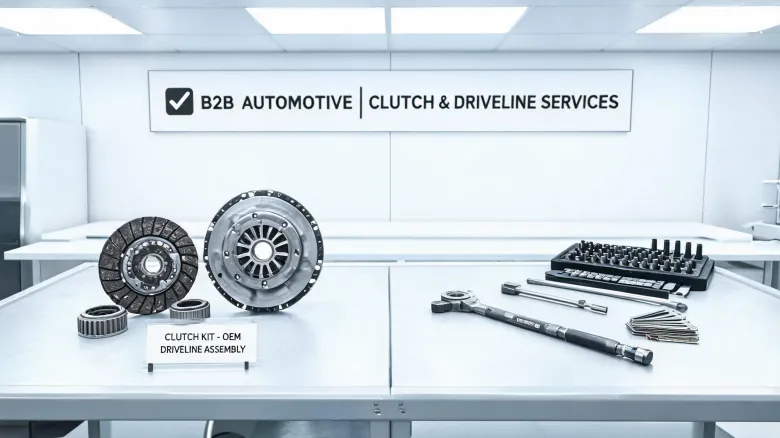
There isn't a single correct EXEDY clutch setup for a Honda Civic. The kit your friend loves for weekend track days can be genuinely miserable in stop-and-go traffic, and the lightweight flywheel that makes his car feel eager can make a street-driven car harder to live with. I learned this the expensive way.
I've spent eight years ordering clutches and flywheels for a living, and I've personally made—and logged—eleven significant mistakes, totaling roughly $7,300 in wasted budget. Now I keep our team's checklist so the next person doesn't repeat them. This article is basically that checklist in prose.
Buyers usually fall into one of four scenarios, and the right part differs for each:
- Daily-driven, mostly stock Civic with a worn clutch — you need predictable replacement behavior, not race-plate drama.
- Track/weekend build — you want response and you're willing to accept extra noise and a less forgiving feel.
- You aren't sure the clutch is actually the problem — the car dies at stoplights or the electrical stuff looks wrong.
- You found a too-good-to-be-true online deal — and you need to know what you're really buying.
Scenario 1: Daily driver, mostly stock
If the Civic is your everyday car, engagement quality matters more than peak torque capacity. For this group, I usually spec an EXEDY Stage 1 Organic Clutch Kit (07802LB). The organic material keeps engagement predictable and pedal effort reasonable—closer to factory feel than to an on/off switch.
Here's a mistake I still wince at: in October 2021, I talked a customer into a more aggressive puck-style kit because he had an intake, a header, and big plans. He never got big plans. He got a 35-minute stop-and-go commute with a clutch that grabbed hard when cold. Twelve days later, we pulled the transmission again and replaced it with an organic kit. Cost: about $1,100 plus the hit to my credibility.
That lesson is now baked into our process: match the clutch to the car and the driver, not to the forum thread.
Scenario 2: Track, autocross, or weekend fun build
If the Civic is primarily a toy, the priorities shift. You want quick rev response, repeatable launches, and heat tolerance. That's where the EXEDY Honda Civic lightweight flywheel (HF501) comes in. Less rotating inertia means the engine revs up and down faster, which makes rev-matched downshifts feel natural and helps on courses where you're shifting constantly.
Let me add an unpopular opinion: a lightweight flywheel does not add power. It changes how quickly engine speed changes. On a fast, high-gear track, you might barely notice it. It also adds driveline clatter at low speed and makes it easier to stall when you're not used to it. If that trade-off is acceptable for your build, fine. If the car will still spend most of its life on public roads, the HF501 isn't the first thing I'd add.
The enthusiasm for the lightest possible flywheel peaked around 2020. By 2025, most of the setups I order balance weight reduction with street manners. The fundamentals haven't changed—friction, clamp load, inertia—but the execution has.
Scenario 3: The car dies at stoplights — wait, alternator, what does it do?
The most expensive mistake isn't choosing the wrong part. It's replacing the system that was never broken in the first place. If the engine stalls right after you push the clutch in and coast to a stop, it's tempting to blame the clutch. But at that point, the clutch is disengaged. It's not doing anything to the engine.
So let's back up. Alternator: what does it do? An alternator is a belt-driven generator. The battery starts the car, but once the engine is running, the alternator recharges the battery and supplies power for the lights, fans, fuel system, and everything else electrical. When its output weakens, you often won't notice until the car is sitting at idle with a few electrical loads switched on. That's when voltage drops, and the engine can stumble or stall.
In November 2023, a customer brought in a Civic with a $2,400 clutch-and-flywheel quote from another shop. The symptom: the engine died when he braked at a stoplight and pushed in the clutch, especially with the headlights and blower on. The clutch friction material was fine. An alternator load test showed charging output well below spec at idle. After we replaced the alternator and belt, the car idled cleanly. He never needed the clutch.
If your problem includes stalling at idle, dimming headlights, or a flickering battery light, do an alternator and battery load test before you order any clutch parts.
Scenario 4: The online deal that is almost too good
Marketplace buying is normal now, but the risk isn't the shipping time anymore—it's whether the box actually contains the EXEDY part it claims to. In the last few years, we've seen convincing-looking listings sell parts that were wrong in ways you couldn't spot in a photo.
Some warning signs are easy to check:
- The price is 30–40% below what authorized EXEDY distributors charge.
- The listing uses generic photos instead of application-specific ones.
- The seller has no automotive parts history to speak of.
Look at the rest of the seller's catalog too. If the same store is also listing an AC condenser capacitor on one page and a wireless dental headlight on another, you're not dealing with an automotive specialist who can answer a fitment question. That alone doesn't automatically mean the part is fake, but it means you won't get an application check from them.
One of our customers bought what looked like the right stage 1 kit from a listing like that in May 2024. The outer box looked fine, but the pressure plate didn't match. The seller accepted the return, but shipping and restocking cost roughly $220, and the job waited three extra weeks. He ended up buying from an authorized dealer anyway.
Which scenario are you in? Ask yourself four questions
- Is the clutch actually slipping? If engine speed climbs without the car speeding up—especially uphill or under load—it's mechanical clutch wear, so read scenarios 1 and 2. If the car is just stalling or cutting out at idle, read scenario 3 first.
- When does it happen? If it only happens with headlights, blower, or rear defroster on at idle, that's an electrical/charging system clue, not a clutch clue.
- Is the car a daily driver or a toy? Daily driver plus mostly stock engine points to scenario 1. Track-focused or highly modified build points to scenario 2.
- Where are you buying the parts? If the source can't verify fitment or the price is far below market, read scenario 4 again.
Once you've picked your path, verify the exact part number against your car's engine code and transmission code. On older Honda Civics, the same model year can have different transmission spline counts, so don't rely on the model year alone.
Since I formalized this checklist, we've caught 47 potential ordering errors in 18 months—before they became someone else's problem. I'd rather ask one annoying fitment question than make another apology call.
Spec the parts to the car, the driver, and the source—in that order. The forum poster doesn't sit in your traffic, and the seller doesn't pay for your redo labor. You do.
Application references in this article are general and current as of January 2025. Always confirm the current EXEDY catalog for your specific Civic application before ordering.