Here's the thing: I don't care if a part is 'within tolerance.' I care about what happens when a customer bolts it on, gets it hot, and drives on it for three years. That's a completely different question.
I'm the person who approves automotive components before they ship. Quality and brand compliance manager at an automotive parts manufacturer—but let me be more honest: I'm the one who says no when the first articles don't hold up. I've been reviewing parts for Exedy for over four years now: stampings, dies, forged parts, aluminum extrusions, CNC machined components. Roughly 200 unique items a year, maybe more during development peaks. I rejected around 11% of first deliveries in 2024, which isn't a source of pride. It's an accurate reflection of how often 'close enough' isn't.
And that's the point: quality is not a specification. It's a judgment based on process, history, and how the part will actually fail.
Paper specs don't tell you how a part lives
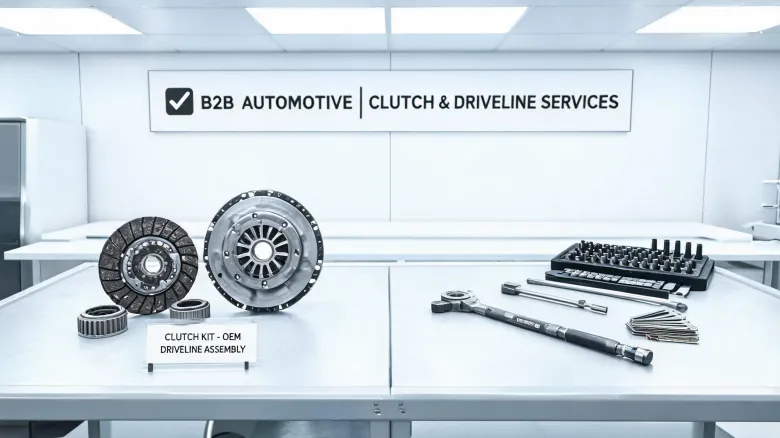
Take the Exedy stage 2 clutch and flywheel kit, for example. It's a popular upgrade, and a lot of people compare it by looking at clamping load and disc composition. Those matter. But the flywheel is where quality gets tricky.
A flywheel can measure perfectly in every dimension and still cause vibration if the friction surface runout exceeds a few microns relative to the crankshaft mounting face. The Exedy fwsbl02ff flywheel is designed for a specific modular assembly, not just as an interchangeable disc of metal. If you treat it as a generic flywheel, you miss the balance, the bolt geometry, and the surface finish requirements that make the clutch engage smoothly.
I still remember a batch of flywheels from a secondary supplier—actually, to be fair, this was us evaluating an outside vendor—where the dimensional report was perfect. Every point was nominal. But the surface finish varied from one side of the friction face to the other. Installed, you'd feel a slight grab during engagement. Not a catastrophic failure. Exactly the kind of annoyance that makes a customer question the whole kit.
That's why I care about assembly-level performance, not just component-level statistics. GD&T tolerances written to ASME Y14.5 are only useful if the supplier actually measures datums the way we do.
Consistency is the real quality signal
When I look at a production run, I don't start at the final dimensions. I start with process consistency. Is coating thickness the same at the beginning and end of the batch? Are batch numbers legible? Arc welds clean? Secondary operations controlled?
I've learned this the hard way. In my first year as a reviewer, I made the classic beginner mistake: I approved a stamped bracket because every critical dimension hit the target. I didn't notice that the coating spec had been changed from the approved sample. It looked similar. It probably even worked for a while. But the customer had signed off on a specific corrosion treatment, and we shipped something 'equivalent.' It wasn't.
That product had to be re-coated. Because we'd already assembled some units, the rework cost us around thirteen grand—I'd have to check the exact number, but it was enough to hurt a small project budget. Since then, every contract I review includes explicit coating and process requirements, not just dimensions.
Another lesson: don't skip final review because you're rushing. I did that once. I thought, 'what are the odds that this batch is any different?' That was the one time it was different. We shipped 800 units with a missing groove on one part. They failed in a vibration bench test at the customer's site. Nobody was hurt, but the words 'critical characteristic' and 'verification point' got a lot more attention after that incident.
I'll be blunt: I trust a supplier less when they hand me inspection data and ask me to accept it as proof. The AIAG's PPAP process is built on evidence of process capability, not just a stack of measurements. If a supplier can't explain their process variation, they don't understand it yet.
Aftermarket exhaust parts show the same pattern
I look at more than clutch and flywheel components. The same logic applies to exhaust parts. A motorcycle exhaust muffler can look perfect from the outside. Outer shell, inlet diameter, mounting tabs—all correct. But internal packing and baffle welds are what determine sound, backpressure, and how long the muffler lasts before it goes raspy.
If you source a muffler mainly by looks and price, you're betting that the manufacturer does internal welds correctly without any verification. Some do. Some don't.
Same with an aero resonator. On paper, it's just a silencer. But internal geometry is what eliminates specific drone frequencies. If the resonator is built with poor internal tolerances, it doesn't make the pipe a little worse. It makes the pipe completely different. It changes the acoustic signature of the whole system. No amount of dyno tuning can fix that.
So no, I don't think 'it's just a tube' is ever true.
What about the 'spec is just a spec' crowd?
I've heard the argument: 'If the part fits and works, why should I care about the process behind it?'
I get it. Price is important. Lead time is important. And I'm not here to say budget-friendly options are always bad. That would be dishonest. But I will say this: the total cost of a failed component is usually a lot higher than the money you saved on the part. Labor, downtime, warranty claims, and brand reputation are not line items on the original purchase order.
Let's use the oldest debate in braking as an example: disc brake vs drum brake. People argue that discs are inherently better. In most performance contexts, yes. But in a commercial vehicle at low speeds? A well-made drum brake with proper material and consistent machining can outperform a cheap disc brake that's prone to thermal judder. The technology isn't the only variable. The quality of execution decides it.
A sloppy disc brake rotor—a casting with uneven wall thickness, for example—will vibrate under braking even if the design is 'better.' The same principle applies to every component I review.
I still think quality is the best brand strategy
Look, I'm not saying Exedy is the only company capable of making good parts. There are plenty of skilled manufacturers out there. But I am saying that brand reputation in automotive parts is not a marketing decoration. It's the accumulated result of thousands of decisions made before the part ships. You can't put that on a sticker. You can only put it in the product.
If you're choosing between two parts and the only difference is the logo, the difference is not the logo. It's what the logo implies about process control, testing, and what happens when something goes wrong.
I've gone back and forth on this in my own buying decisions. I remember choosing between a lower-cost supplier and our own established process for an $18,000 project. On paper, the lower-cost supplier was fine. My gut said the established process was safer. I chose our process because the project was too visible to gamble. It wasn't a glamorous decision. It was a risk calculation where quality was the deciding variable.
That's how I look at every part that crosses my desk. Not as a drawing to be checked, but as a risk to be managed. At least, that's been my experience in this corner of the automotive supply chain.
And in this industry, the ones who manage risk best are the ones customers never have to think about. That's the kind of quality I care about.