I've been coordinating supply for an automotive parts manufacturer for eight years. In that time, I've processed more than 200 rush orders—including one in March 2024 when a customer was 36 hours away from a line stop. That experience changed how I look at price versus cost. This article compares OEM and aftermarket parts across four categories: clutch kits, oxygen sensors, oil pumps, and radiators. The goal isn't to tell you which brand to buy. It's to show what a price tag doesn't include.
The comparison framework I use
Most part comparisons start with the sticker price. I don't. When I'm triaging a rush order or helping a shop source a replacement, I look at three things:
- Engineering match – Did the part reproduce the original manufacturer's specifications?
- Failure risk – What happens if this part fails in service?
- Total cost – Purchase price plus labor, downtime, diagnosis, and comebacks.
If you only look at the first number, aftermarket parts often look great. When you look at all three, the picture changes—but not always in the direction you'd expect.
Clutch kits: Exedy OEM vs. budget rebuilds
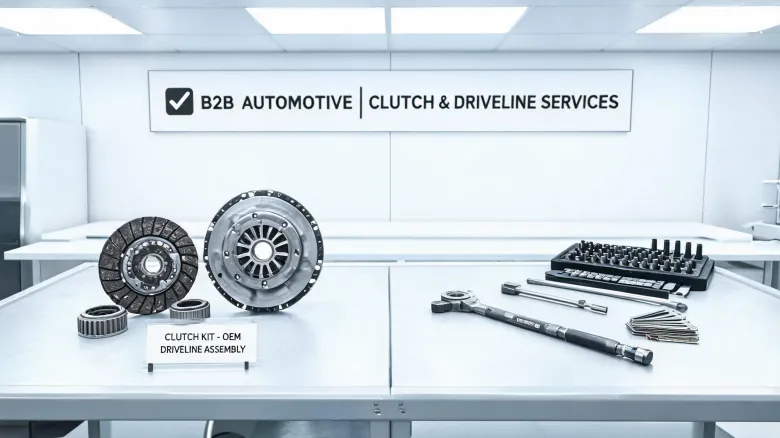
Clutches are where I see this play out most. A clutch kit isn't just a friction disc. It's a pressure plate, disc, release bearing, and sometimes a pilot bearing. All of those parts have to work together. The last thing you want is a kit that engages at a different pedal height or shudders when hot.
This is where an Exedy OEM clutch kit earns its place. Automakers specify the original clutch to a particular pedal feel, release curve, and torque capacity. Exedy builds to that spec. When a factory service part gets delivered in an Exedy box, you're not getting a "close enough" version—you're getting the production component. Exedy transmission clutch kits are a common factory choice because they reproduce the original engagement behavior.
I remember March 2024, a customer called on a Tuesday morning. They needed 40 clutch kits for a line restart on Thursday afternoon. Normal lead time for that spec was ten days. We had two hours to decide whether to pay air freight and pull inventory from another location. In hindsight, it was an easy call. But at the time, with an extra $2,300 in shipping and no guarantee a supplier would pick up the phone, it felt like a gamble. We went with the known supplier. The kits arrived with six hours to spare. The cost of missing that deadline would have been a production shutdown—probably five figures.
The cheaper route? I've seen it. A shop saves $80 on a discount clutch kit, then charges the customer twice because the first one chatters. That $80 savings turns into $400 in extra labor and a reputation hit. The "budget" option wasn't a saving. It was a loan.
O2 sensor price: the $25 that costs $350
Now let's talk about something with a much lower price tag: oxygen sensors. The O2 sensor price is one of the first things people Google when they get a check engine light. At major U.S. auto parts retailers in early February 2025, O2 sensor price ranged from roughly $20 for a splice-in universal sensor to $95 or more for a direct-fit unit with the correct connector (Source: public online retail listings; prices vary by vehicle—verify current pricing).
Here's what I tell people: A universal sensor often works fine. But "often" is not "always." The sensor's response time and calibration have to match what the ECU expects. If they don't, you can end up with a lean code that comes back time after time. I've seen a $25 sensor cause a misdiagnosis that cost $350 in labor before the right sensor was installed. The $70 savings disappeared, and the car still wasn't fixed.
That's the value over price point I keep coming back to. The cheapest O2 sensor is only cheap if it solves the problem on the first install. If it creates a second trip to the shop, it's the most expensive option in the bay.
2JZ-GTE oil pump: the part you don't gamble on
Some parts fail gracefully. An oil pump doesn't. This is especially true on a 2JZ-GTE, where finding a good block matters more than the $150 you might save on a no-name pump.
A 2JZGTE oil pump has to survive high oil pressure, high heat, and sometimes serious track time. If it fails, it's not usually "replace the pump." It's "tear down the engine and check for spun bearings." That's the kind of surprise that turns a modest build into a full rebuild.
I've made this mistake. Looking back, I should have specified a known pump on my own vehicle. At the time, the budget pump seemed like an acceptable risk—it was a fresh OEM-style pump from an online seller, not some used part, so I assumed it was made to spec. It didn't fail catastrophically, but the oil pressure was low at idle from day one. The peace of mind cost more than the pump. If you're doing a 2JZ-GTE build, put the oil pump in the "do not save here" column. That part only gets one chance.
How a radiator works, and why cheap cores fail
Radiators don't get the same emotional attention as engines or transmissions, but they're just as important. Here's how a radiator works: coolant flows through a series of small tubes, heat from the coolant transfers to the metal tubes, then to thin fins attached to the tubes, and finally, air moving through the fins carries the heat away. The bigger the total surface area—and the better the airflow path—the more heat the radiator can reject.
That explains why two radiators can look identical from the outside and perform completely differently. A cheap replacement may have the same plastic tanks and same dimensions, but fewer fins, thinner tubes, or a lower fin density. It fits perfectly. It still moves coolant. And at highway load, it runs 10 degrees hotter because it simply doesn't have the surface area to shed heat. "It works" is technically true. It works right up until the moment it doesn't.
This is another case where I'd rather buy a radiator with known core specifications than one whose only selling point is fitment. The radiator doesn't have to be OEM—but it does have to match the original cooling capacity, not just the mounting points.
When aftermarket actually makes sense
Before you assume I'm anti-aftermarket, I'm not. Some aftermarket parts are legitimately better. High-flow water pumps, performance oil coolers, upgraded intercoolers—these can improve on factory parts. My point is that the decision should start with failure cost, not price tag.
Here's a quick way to decide:
- If the part affects drivetrain engagement (clutch), use the OE spec. An Exedy OEM clutch kit is the safe choice.
- If the part affects emissions or engine management (O2 sensors), buy a sensor with the correct harness and calibration. Splice-in universal sensors can work, but expect to spend time verifying.
- If the part lubricates or pumps oil (2JZ-GTE oil pump), don't gamble. This is where a failure is most expensive.
- If the part manages heat (radiator), compare core construction, tube count, and fin density—not just dimensions.
And if you're in an emergency situation—deadline, production stoppage, customer waiting—don't automatically reach for the fastest supplier. Reach for the supplier who can get you the right part quickly. "Fast" only helps if the part works the first time.
Bottom line
The real comparison isn't OEM versus aftermarket. It's matched versus guesswork. When you buy a part that matches the original design—whether it's an Exedy OEM clutch kit or an OE-style O2 sensor with the correct connector—you're buying certainty. Certainty matters when a failure means a comeback, a tow bill, or a torn-down engine.
In my experience, the lowest price is rarely the lowest total cost. That's not a slogan. It's a pattern I've seen repeatedly over 200+ rush orders and a few mistakes of my own. If you're balancing a repair budget, the best question to ask isn't "What's the cheapest part?" It's "What's the cost if this part fails—and who's responsible then?"