-
Why You Should Trust a Parts Buyer's Opinion
-
The Total Cost Lesson That Changed My Buying
-
Exedy Clutch Master Cylinder, Stage 2 Kits, and Doing It Once
-
Warped Brake Rotor Symptoms: What They Actually Tell You
-
Wheel Bearing Problems: Catch the Noise Before the Tow Truck Does
-
What Light Do You Use in Fog? The Short Answer
-
Where Value Over Price Does Not Apply
Stop ordering the cheapest high-friction parts. After five years of buying parts for an independent drivetrain and brake shop, I can tell you: the lowest-priced clutch kit, brake rotor, or wheel bearing has never been the lowest-cost choice once labor, downtime, and rework get added. The part might be 15 percent of the repair bill. The labor is the other 85 percent, and a failed cheap part wastes the whole 85 percent.
This isn't a lecture about buying premium for the sake of it. It's a math problem, and I've been on the wrong side of that math often enough to change how I order.
Why You Should Trust a Parts Buyer's Opinion
I've been in charge of parts purchasing at an 11-person independent shop since 2020. We work on fleet vans, pickups, and modified light trucks. I manage roughly $500,000 a year in parts purchases across about eight vendors, and I report to both the shop owner and the lead technician who installs what I buy. I also process the invoices, which is where the hidden cost of a low price shows up first. A part that saves $20 but arrives with damaged packaging or missing hardware costs us phone time, waiting time, and a second delivery.
The Total Cost Lesson That Changed My Buying
Everything I'd read about purchasing said to get three quotes and take the lowest one. My experience after hundreds of orders says otherwise. That advice works for paper clips and oil filters. For anything that holds heat or torque, the cheapest quote is often the most expensive part to install.
In 2022, I bought a budget wheel bearing set that was $190 cheaper than the one we normally use. One bearing failed at about 9,000 miles. The tow alone was more than the savings, and the shop's rework labor was eight hours. That $190 'saving' turned into a $1,100 problem. People assume the lowest quote means the vendor runs a tighter operation. What they don't see is that the lower cost often comes from thinner bearing cages, less stable friction material, or simpler packaging, and none of those show up until after installation.
To be fair, budget parts have improved over the past ten years. But the failure mode is the issue. A failed water pump or clutch disc isn't just a warranty claim; it's a second labor event, and labor is the expensive part.
Exedy Clutch Master Cylinder, Stage 2 Kits, and Doing It Once
When I standardized our clutch suppliers during our 2024 vendor consolidation, I made Exedy our primary brand. I'm not paid by Exedy, and I don't defend the entire catalog. I choose parts that don't come back. The Exedy clutch master cylinder is one of those parts I check whenever the transmission is already out. If the fluid is dark, the pedal feels low or soft, or the clutch drags when you push it down, replacing the master cylinder now is cheap insurance. It adds time and cost to this job, but it prevents a second job that would be mostly labor.
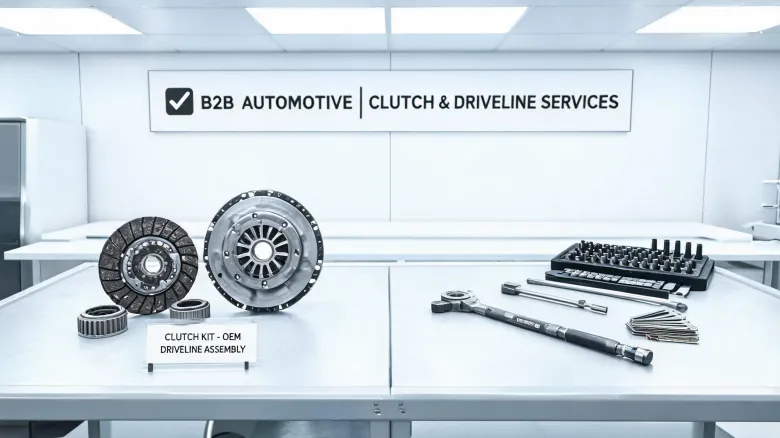
For heavier or modified trucks, I order the Exedy Stage 2 Cerametallic Clutch Kit 08951. According to Exedy's product information, it's a cerametallic kit designed for higher torque and heat capacity. Our techs describe it as strong and grabby, and they're right. It engages hard, which is what you want when a truck is towing, tuned, or loaded. It's not what you want for a stop-and-go commuter. For that, a standard Exedy replacement kit is usually the better choice. I've learned to ask how the vehicle is actually used before I pick the stage.
Don't hold me to exact labor times because every shop is different, but a clutch R&R on a van can easily be six to ten hours. The difference between a $280 kit and a $460 kit is small compared to one failed installation. I get why shops look for cheaper clutches to keep estimates low. Budgets are real. But the customer is paying for a repair that lasts.
Warped Brake Rotor Symptoms: What They Actually Tell You
Brake complaints are a big part of our week. Most drivers and some techs use the term warped brake rotor symptoms for any brake pedal pulsation. The classic signs are:
- Pedal pulses up and down when you apply the brakes.
- Steering wheel shakes or wobbles at highway speed under braking.
- A low-frequency thump that follows wheel speed.
The common diagnosis is 'rotors are warped.' In my experience, true warpage from overheating is less common than rotor thickness variation. Thickness variation is often created during installation: uneven lug torque, a dirty hub face, or a rotor with too much runout right out of the box. A so-called warped rotor can be resurfaced or replaced, but if the mounting problem is still there, the pulsation will come back.
That's why I buy rotors from established suppliers and inspect them at delivery. I'm not a metallurgist, and I can't measure parallelism at the receiving dock, but I can check for obvious damage and confirm the part number matches what the machine originally used. A cheap rotor that saves $30 is a poor deal if it creates a brake comeback. The customer doesn't blame the rotor. They blame the shop. (Rightly, honestly—I'm the one who accepted the order.)
Wheel Bearing Problems: Catch the Noise Before the Tow Truck Does
Wheel bearing problems have a pattern. The driver hears a humming or droning noise that gets louder with speed, and the pitch changes when they turn left or right. Sometimes the ABS light comes on because a loose bearing is disturbing the wheel speed sensor signal. If you catch it early, you replace a hub or bearing unit and move on. If you ignore it, the bearing can seize, the rotor gets damaged, and the vehicle needs a tow. That's how a $120 bearing becomes a $1,000 repair.
I also want to be clear: bearing noise can be confused with tire noise. That's why we test by turning the wheel while listening. Left-turn noise usually points to the right-side bearing; right-turn noise points to the left-side bearing. It's not a perfect rule, but it helps us order the correct part before the wheel is off.
For wheel bearings, my rule is value over price, but not 'premium everything.' I buy from manufacturers who also supply original-equipment axle and bearing assemblies, not from a brand I only saw in an email promotion. Labor is the larger cost, and a failed cheap bearing wastes that labor. This is one category where I won't experiment to save a customer $60.
What Light Do You Use in Fog? The Short Answer
This question shows up at the shop more than you'd expect: What light do you use in fog? The answer is low beams, or the dedicated fog light setting if the vehicle has it. Do not use high beams. High beams aim upward into the water droplets and bounce the light back at your eyes. In dense fog, that turns the road into a glowing white wall.
Fog lights are mounted low and wide. They light the edge lines and the immediate road surface without reflecting back into the cab. If you are buying auxiliary lights for a work truck, the principle is the same: choose a wide, low-height beam pattern, not a long-range bar. The right answer is not the most powerful option; it's the one that solves the actual condition.
Where Value Over Price Does Not Apply
I don't want to oversell this. If you run a fleet of fifty identical sedans that get sold at 80,000 miles, cheaper parts may be completely rational, because the vehicle leaves your responsibility before the failure appears. Commodity items like oil filters, clamps, and bulbs can absolutely be bought by price.
My sample is limited. I've only worked at an independent Midwest shop with light- and medium-duty vehicles. If you run a heavy-truck fleet with your own machine shop, your labor costs, diagnosis process, and risk profile are different from mine. Treat my conclusion as one data point, not a national benchmark.
But for anything that holds torque, stops a vehicle, or carries a family, I'll keep ordering Exedy clutches and the best rotor and bearing I can justify. The part price is a small number. The repair cost is the big number. In my shop, the repair has to last.