I'm the office administrator for a 40-person company. In addition to workstations, toner, and the never-ending question of which coffee service to use, I manage roughly $180,000 a year in purchases across about eight regular vendors. That includes parts for our five work vehicles—two sedans, a pickup, and two vans that carry our field techs and materials.
In March 2023, two of our fleet Honda Civics—a '95 hatch and a '97 sedan—both needed clutch replacements in the same month. Both manual, both daily-driven, both well past 180,000 miles. I'm not a mechanic. I'm the person with the purchasing card, which means I do the research, place the order, and explain to my VP why the car that was supposed to be back on the road by Friday is still on a lift.
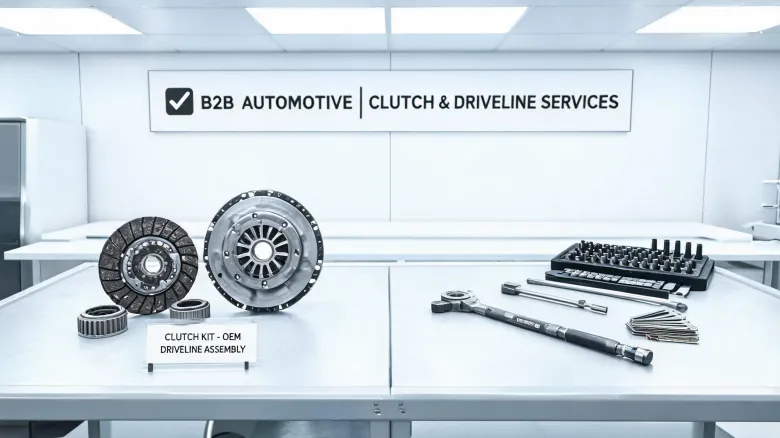
So I searched. “Clutch kit for 1992-2000 Honda Civic.” A hundred results came back, all looking fundamentally interchangeable: same round pressure plate in the listing photos, same splined disc, same throwout bearing. The price was the only real difference—$85 to $340 (based on a March 2023 search; prices have moved since). Why would anyone pay four times as much for the same-looking part?
Eight days and $540 later, I had my answer.
The Real Problem: “92-00 Civic” Is Not One Car
Let me save you the research bill I paid.
The 1992-2000 Honda Civic actually covers two separate generations: the EG/EH series, which ran from 1992 to 1995, and the EK/EJ series from 1996 to 2000. Different chassis, different transmission families, different clutch assemblies. Not “different enough to double-check.” Different enough that a clutch kit for one will not fit the other.
Even within a single generation, the engine matters. A base model with a 1.5L engine takes a different clutch than the D16Z6 in the sportier trim. The disc alone is a different diameter—200mm versus 212mm in this case. Search for a “92-00 Civic clutch kit” and you're asking for a part that spans different part bins under the same model name.
That's the first layer of the problem: a search term that seems precise actually isn't.
What Actually Happened: The Engine Code Surprise
I placed an order for two clutch kits—same part number, both based on the sedan's application. I remember thinking the hatch has to use the same thing, right? Same model, same era. The mechanic had said “check the engine codes first.” I thought, what are the odds the engine code matters for two stock commuter cars?
The odds caught up with me. The '95 hatch had been modified before we bought it: the original 1.5L was gone, replaced with a D16Z6 out of a 1993 Civic Si. The swap was well done, which made it dangerous in its own way—the car ran fine, the wiring was clean, and no one had written anything down. The vehicle file in our office said “1995 Civic DX, 1.5L.” The engine bay said something else entirely.
When the shop dropped the transmission and pulled the old clutch, the truth emerged. The kit I'd ordered for the sedan had a 200mm disc. The hatch needed the 212mm unit that matches the D16Z6. The disc didn't fill the flywheel face, and the pressure plate bolt holes didn't line up. Nothing about it fit.
The shop had done their part. The mistake was mine, and it was in the specification I provided.
Why “OE” and “Stage 1 Organic” Are Not What You Think
Here's the second layer of the problem: the naming.
The Exedy OE clutch kit for the 1992-2000 Honda Civic is engineered to reproduce the factory clutch exactly. Friction material, pedal curve, engagement window—all designed to match what Honda originally built. If your Civic is stock and you want it to drive like a stock Civic, the OE kit is the correct choice. “OE” isn't a marketing label. It's a specification target.
According to Exedy's product information (exedy.com), the OE replacement line is designed to match original equipment specifications, while the Stage 1 organic kit is positioned as a sport-oriented replacement for daily-driven vehicles. That's how I eventually understood the difference: one is built to restore, the other is built to endure a bit more than factory life.
The Exedy Stage 1 organic clutch kit uses a different friction compound—organic, as opposed to the standard material—with a modestly increased pressure plate clamp load. The engagement stays smooth enough for city traffic, but the clutch holds up better under heavier loads. It's the right answer for the hatch that carries our field tech's entire workshop in the back.
Here's the catch: “stage” means nothing on its own. There's no industry-wide definition for what a “Stage 1” clutch is. Exedy's Stage 1 and another brand's Stage 1 are not the same product, and comparing them on paper is comparing two companies' completely different engineering choices. The same is true for the word “kit,” which is why the parts list matters more than the marketing copy. (I know this now. I definitely didn't then.)
So when someone asks whether they should buy the Exedy OE kit or the Exedy Stage 1 organic kit for a 92-00 Civic, the honest answer is: it depends on the engine code and the use case. Stock commuter? OE. Hauls gear and climbs hills? Stage 1 organic. Building a serious track car? You're not shopping for either of those—more on that below.
What the Wrong Clutch Kit Costs
Here's what a wrong clutch kit costs, in numbers:
- Expedited shipping for the correct kit: $120.
- Extra shop time with the car sitting on the lift: $220 (after the shop discounted some labor out of goodwill).
- Rental car for the tech whose route depended on that hatch: $160.
- The wrong kit itself, opened and test-fit, unreturnable: $85.
That's $585 on paper. The shop wrote off part of the labor—they'd also missed the mismatch during their inspection—so our net was closer to $540. And that number still leaves out the part no spreadsheet can capture: telling my VP the car would be late. The pause on the phone when you say “we'll need until Thursday” is its own cost.
We didn't have a formal parts verification process. I assumed the VIN would tell the whole truth. It didn't. And the vehicle file had never been updated after the engine swap, so the paperwork actively misled me. I still kick myself for not walking to the shop and asking the mechanic to look under the hood before I ordered. One minute of checking would have avoided all of it.
Looking back, I should have ordered after the car was on the lift, not before. At the time, I wanted to get the order in before the weekend, so I rushed. If I could redo that decision, I'd let the urgency wait.
Which Exedy Kit Do You Actually Need?
This is where I tell you what we did—and what I won't pretend about.
For the '97 sedan—stock D16Y7, flat delivery routes, nothing heavier than a crate of paperwork in the trunk—we bought the Exedy OE clutch kit. It drives like a factory part because that's what it's engineered to be.
For the '95 hatch—D16Z6 swap, carries toolboxes, driven like the daily workhorse it is—we bought the Exedy Stage 1 organic clutch kit. It handles the extra load, the pedal is still acceptable in stop-and-go traffic, and my field tech hasn't complained about chatter or stiffness. That's the test that matters.
Both of the specific Exedy kits we ordered included the release bearing and an alignment tool, which I appreciated. I've been burned before by another brand's “complete kit” that arrived missing the release bearing. So I still read the included-parts list on every product page before ordering. The word “kit” is not regulated by anyone, and the description beats the label.
The honest part: if your Civic is a project car with a turbo, a B-series swap, or serious power goals, neither the OE kit nor the Stage 1 organic is the right product. Exedy offers other clutch lines for higher demands, and you should research those based on your actual power output and driving. I'd rather lose a search click than send someone down a parts path that doesn't fit their build. There's no one “best clutch for every 92-00 Civic.” There's only the right clutch for the car you actually own.
And the same logic extends to parts outside a manufacturer's lane. Exedy makes driveline components, not steering and suspension parts. When one of our shop trucks needed a Jeep JK ball joint, I went to a suspension specialist. You don't buy a clutch from a ball joint company, and you don't buy ball joints from a clutch company. Match the expert to the component.
This pattern shows up in every category I buy for. I order differential mode chokes for our engineering team's EMI filters, and the same rule applies: “close enough” on the datasheet means a filter that doesn't filter. Likewise, I've sat through enough IT debates to know the difference between incremental and differential backups—incremental saves what changed since the last backup; differential saves everything since the last full backup. Different recovery scenarios need different strategies. Nobody hands you a manual that says buying auto parts, electronic components, and backup plans uses the same skill—but it does: matching the specification to the actual situation.
The Bottom Line
These days, a one-page checklist travels with every parts order for our fleet: VIN, engine code, transmission code, known modifications, and a line for the mechanic to sign after physically confirming. It took a $540 mistake to build that checklist. We've used it twice, and the second time it caught a discrepancy before the part was ordered. The mechanic looked at me and said, “This is why we have this now.”
The checklist also gives our accounting team a clean trail: every part is tied to a VIN and a PO number, which makes the auditors a little less scary. That's a side benefit I didn't expect.
There's something satisfying about fixing a process after it breaks you once. I hope this article saves you the same tuition. Know your engine code. Verify the vehicle's history. And when you're choosing between the Exedy OE clutch kit and the Exedy Stage 1 organic clutch kit, don't ask which one is “better.” Ask what the car is, and what the car does. The right part will be obvious after that.