Five years ago, I wrote a return label for a 2013 Audi Q5 headlight. I'd been sure the part was right. The part number matched, the photo looked like the one on the customer's bench, and the website said it fit a 2013 Audi Q5. Then the technician found the connector was wrong. The order was a $680 correction and a week of delay.
If you've ever ordered an OEM replacement part and watched it come back, you know the feeling. Trust me, I've been there more times than I like to admit.
I'm a production engineer at Exedy, handling aftermarket orders for 11 years. I've personally made and documented nine significant mistakes, totaling roughly $28,000 in wasted budget. Now I maintain our team's checklist to prevent others from repeating my errors. In my first year (2014), I made the classic fitment error: I ordered a kit based on model/year and forgot to check the production date. Cost me a $600 redo and a five-day delay.
Honestly, the part that taught me the most was the Exedy 07099 OEM replacement clutch kit. Not because it's a bad kit. It isn't. But it is the perfect example of why a catalog lookup is not the same as a fitment check.
The problem starts when the catalog looks right
The Exedy catalog is one of the better catalogs in the industry. It has application lists, kit components, torque specs, installation notes. But a catalog is basically a map, not the territory. It can tell you what part was originally installed in a model. It cannot tell you which changes happened during that model's production run.
I have mixed feelings about catalog lookups. On one hand, they are faster than the paper cross-references I used in 2014. On the other hand, they create false confidence. You see a clean image, a compatible vehicle list, and a part number that starts with OE. You stop asking questions.
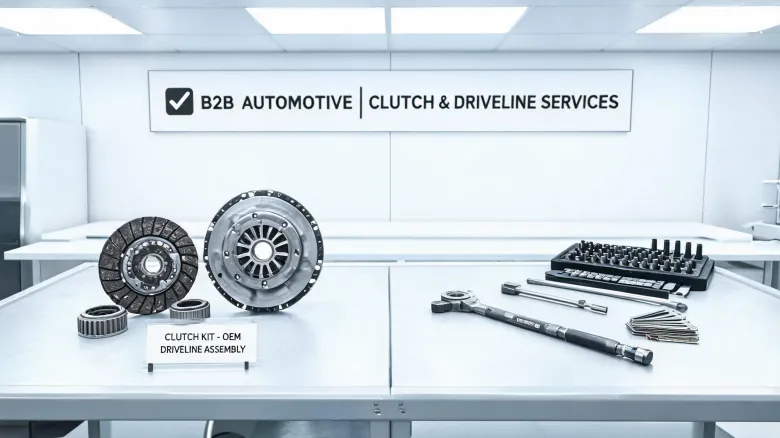
The Exedy 07099 OEM replacement clutch kit, for example, looks straightforward in the listing. It's a kit: disc, cover, bearing, pilot tool. But the same kit may need to be paired with a specific flywheel or release fork in certain production windows. If you order from the photo and skip the note, you are ordering hope, not certainty.
The deeper cause: you're buying a system, not a single part
Here's the part that took me too long to understand: a car is a set of systems, and a replacement part is only correct when you consider the system around it. The deep reason parts get returned isn't usually a typo. It's a mismatch between the part's specification and the vehicle's actual state at the point of installation.
To understand why this happens, you need to stop thinking about a part as an isolated item. In manufacturing, a part number is only a pointer to an engineering specification. When something changes upstream—a material grade, a coating, a sub-supplier—the revision changes. But the catalog image often doesn't.
Take a 2013 Audi Q5 headlight. It looks like a headlight. But inside that housing there is a harness, a ballast or ignition module, and sometimes a leveling sensor. There are adaptive and non-adaptive versions. The connector can be different. The same model year and trim can still have multiple variants.
Or take exhaust systems. If someone asks me about a Helmholtz resonator exhaust calculator, I know they are trying to solve a real problem: drone at a certain RPM, usually because a muffler or resonator was replaced with something that looks similar but doesn't match the system. The physics is simple: resonant frequency changes with pipe length, chamber volume, and neck area. Change one dimension by a few millimeters and the frequency moves. The part can be within drawing tolerance and still be wrong for the acoustic system.
Under IATF 16949, a production change that affects fit, form, or function needs to be documented and controlled. That is a big deal on the manufacturing side. But in the aftermarket, a catalog photo does not change when a supplier revises the part. The photo is the same; the note is different. If you don't read the note, you don't see the change.
The same logic applies to catalytic converters. When someone asks how long does it take to change a catalytic converter, the obvious answer is book time—1.5 to 2.5 hours for a typical petrol car. But the better answer is: it depends on whether the converter matches the engine's calibration, sensor layout, and emissions standard. A part that fits but triggers a check engine light isn't a fit.
The real price of a confident wrong order
Let me be specific about what these mistakes cost.
The Audi headlight cost $680 in reorder expense plus the lost time on the customer's vehicle. I could have caught it in five minutes by checking the connector style. I didn't, because I was confident. I knew I should ask for the VIN before ordering, but I thought, 'how different can a 2013 Audi Q5 be?' The odds caught up with me.
A few years earlier, I was on a 250-piece order where every single item had the wrong hole position because we used the wrong revision drawing. The stamping looked right. The parts were bent and coined correctly. But the holes were 1.2 mm too far apart. What should have been a straightforward production order turned into a $3,200 scrap bin, a one-week delay, and a phone call I still remember.
On the clutch side, I've seen return rates improve when people stop guessing. We've caught 47 potential errors using this checklist in the past 12 months. Maybe 50, I'd have to check the log. But the point isn't the exact number. The point is that these were not exotic failures. They were simple misses: missing VIN codes, missing engine codes, missing production dates.
That is why I'm deliberately not giving you a simple answer to how long does it take to change a catalytic converter. If you know the exact converter is correct, the job is a morning's work. If you don't, it's a morning plus a return cycle, a warranty claim, and an unhappy customer.
The checklist that saved us
After the third rejection in Q1 2024, I created our pre-check list. It's not complicated. It's the list I wish someone had handed me in 2014.
- Get the full VIN, not just model/year.
- Check the engine code and production date.
- Cross-reference the original OEM part number and revision notes.
- Look for the 'covers' and 'does not cover' notes in the catalog.
- If the part belongs to a system, list the adjacent parts that need to match.
That last point is the one that matters most. A part is never just a part. The clutch kit needs the right flywheel. The resonator needs the right pipe length. The headlight needs the right connector. The converter needs the right calibration.
The checklist doesn't replace experience. It makes experience less expensive. On the production floor, automation helps. Our stamping lines need less manual intervention than they did ten years ago. But automation is only as good as the spec that feeds it. The automated press can't tell you that the hole size changed for the 2015 model year.
Switching to this checklist cut our fitment-related returns by about 40% last year. That's not a marketing number; it's our internal return log. The efficiency gain came from a simple idea: slow down at the front end so you don't stop at the back end.
Trust me on this one. The next time you're sure a part fits, ask yourself what system it lives in. The answer will save you a return label.