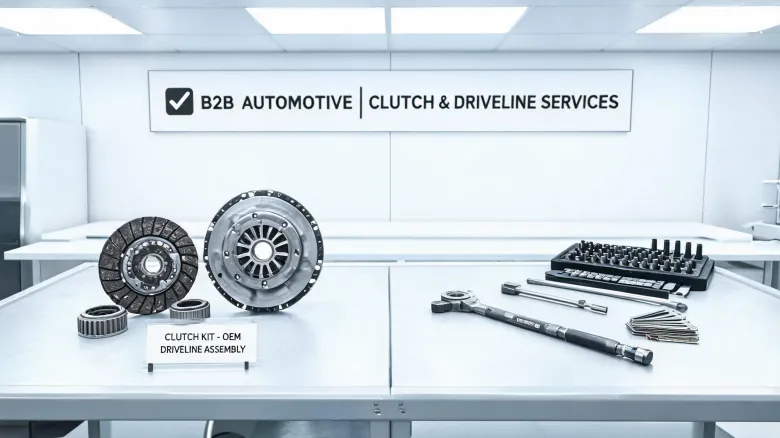
It was a Tuesday morning in March 2025 when Mike called. Mike owns a repair shop about 40 miles from us—not a big operation, just two lifts and a lot of loyal customers. He had a 2005 Nissan 350Z sitting on one of those lifts, and the clutch pedal was going to the floor and staying there. 87,000 miles on the original unit, he said. The car was in for the big one.
Nothing unusual about that. We ship 350Z exedy clutch kits every week. What made this call different was the list Mike gave me before hanging up: exedy automatic transmission clutches for a different car he had in the shop. NGK BPMR7A spark plugs for the 350Z. A 383 crankshaft kit for what he called "a little side project." And then, sort of as an afterthought, how to change the engine air filter.
I sat there with the phone pressed to my ear, thinking: four of the five things he just asked about are not clutch kits.
What our lane actually is
Let me put some context around who I am and what I do. I'm a quality inspector at Exedy's distribution operations. I review every clutch kit before it reaches a customer—roughly 2,000 individual kits a year. In 2025 so far I've rejected about 1.2% of first deliveries: pressure plate bolt patterns off by a couple thousandths, friction material surfaces that didn't meet our finish spec. Small stuff. The kind of small stuff that turns into big problems at 6,000 rpm.
Last year we caught a batch of pressure plates where the diaphragm fingers sat 0.2mm high against the release bearing contact surface. Normal tolerance is 0.1mm max variation. The supplier said it was within "industry standard." I didn't care what they called it—it wasn't within ours. They redid the batch at their cost. That's the job.
Our product range is focused. We make manual transmission clutch kits like the 350Z exedy clutch kit Mike needed. Automatic transmission clutches. Flywheels, release bearings, pressure plates. Underneath all that, we run our own stamping, forging, CNC machining, and aluminum extrusion—and we build our own dies and molds in-house. That's rare in this industry, and I'm pretty proud of it. But all of it serves one goal: making better clutch and powertrain components.
We are not, and have never claimed to be, a general auto parts supplier.
The list Mike gave me
Here's the part of my job that's both frustrating and predictable: every week, someone calls about a clutch kit and then asks if we can "also source" five other things that have nothing to do with clutches. It used to drive me up the wall. Somewhere along the way I realized it's not the customer's fault—it's actually kind of a compliment. They're trusting us to know the answer, or at least point them in the right direction.
Mike's list kicked off with the easy stuff. The 350Z exedy clutch kit: yes, we had it in stock. Disc, pressure plate, release bearing, pilot bearing, all in the box. I confirmed fitment for his 2005 model year and told him to look for the alignment tool we include. That took four minutes.
Exedy automatic transmission clutches was also our territory. This one was for a 2003 Altima with a slipping trans. I asked him to check the transmission code first, because some model year splits used different clutch pack configurations. If I remember correctly, I quoted a 30-day lead time. Might have been 45—I'm mixing it up with another order from around then.
Then we got to the parts I couldn't help with.
The moment I had to say no
NGK BPMR7A spark plugs. I know this plug. It's a common factory fit for the Nissan VQ35 engine, which is what's in the 350Z. I know NGK makes good plugs—they've been doing it for decades and they back their heat ranges with real engineering data. What I don't have is the testing history to tell Mike "these are right for your customer's specific setup." If the engine is near-stock, the factory spec is probably the answer. If there's a tuner involved? Different story. That's not my expertise.
The most frustrating part of conversations like this: I can see exactly what the customer needs, and it's not me. It's someone who lives and breathes spark plug applications. So I told Mike to call NGK's tech line or check their application guide. They make the plug. They have the data. They'll tell him if BPMR7A is right for that car.
I didn't expect his reaction.
"Honestly? That's refreshing," he said. "Nobody ever tells me what they don't know."
The 383 crankshaft kit was even further outside my lane. Mike was building a Chevy small block on the side—summer project. He wanted to stroke it to 383 cubic inches and was shopping for a rotating assembly. I know enough about engine building to be dangerous, which is exactly why I shouldn't be giving specific advice. But I did tell him what I look for when auditing a supplier, because that part is universal: verify stroke against deck height, check rod journal size against your connecting rods, confirm internal vs. external balance. I also named a couple of dedicated engine parts specialists I'd check with if it were me.
Was that complete advice? No. But it was honest about its own limits.
The air filter question
Mike asked about the engine air filter half-joking, like he was testing whether I was still paying attention. "You got any tips on how to change the engine air filter? I hear it's pretty technical."
I laughed. But it's actually a fair place to think about boundaries in the other direction. Changing an engine air filter is one of the most straightforward maintenance jobs on any car. On a 350Z, the filter box sits right on top of the engine, held by two clips. Open the clips, lift the old panel out, drop the new one in, snap it closed. Ten minutes, no tools. It's the kind of task you hand to someone who's never opened a hood, just to get them comfortable.
But even something that simple has a boundary. If the car has an aftermarket cold air intake, that's a cone filter, not a panel, and some of those are oiled. If it's a track car, you might want different flow characteristics than a daily driver. The "right" answer depends on context.
The question isn't "is this hard?" The question is "do I have the specific knowledge for your specific situation?"
What happened after the call
Mike installed the 350Z exedy clutch kit the following week. He sent me a photo on Friday afternoon: the car back on the ground, a thumbs-up from his lead tech, and a caption that said "Clutch is perfect. Thanks for not pretending to know about spark plugs."
Two weeks later, he ordered exedy automatic transmission clutches for the Altima. He started referring other local shops to us. When I asked why—given that we'd punted on half his original list—he said something I haven't stopped thinking about:
Because when you told me you didn't know about spark plugs, I knew I could trust you about clutches.
That's the whole game, right there. Trust is the currency in automotive parts. A shop owner who gets burned by bad advice doesn't just lose money on a part—they lose labor, downtime, and maybe a customer's confidence in their shop. When a supplier says "I don't know" at the right time, it doesn't cost them anything. It proves that when they do make a recommendation, you can take it to the bank.
Lessons about expertise boundaries
It took me about four years and maybe 300 calls like this one to understand that the "we can handle anything" approach is a trap. Usually it means "we'll get to it eventually and hope it works out." I'd rather work with a specialist who knows their limits than a generalist who overpromises. That's not just a preference—it's a risk management decision.
Here are a few things I've learned, from the quality side of the parts world:
Lesson 1: Ask suppliers what they don't do. It sounds backwards, but it's the fastest way to filter for confidence. A supplier who can name their own boundaries is a supplier who has thought seriously about what they offer. A supplier who says "we can handle anything" is showing you a red flag.
Lesson 2: Knowing facts isn't the same as having experience. I can tell you the factory spec for an NGK BPMR7A. I can explain what a 383 crankshaft kit includes. But neither of those means I should be making the call on them. Put another way: knowing that BPMR7A is a part number is not the same as knowing which plug your customer's engine actually needs. Specialists have failure data and real-world cases behind their recommendations. Use them.
Lesson 3: The cost of a wrong part is always bigger than the part. I see this daily in quality control. A bad clutch kit costs more than its box price. It costs installation labor, a second teardown, vehicle downtime, maybe a permanent lost customer. When a supplier knows what they're doing, they prevent all of that. When they don't know but sell to you anyway, they're not saving you money—they're charging you double later.
The bottom line
This approach works for us because Exedy has a clear lane and stays in it. Maybe it's different for someone who's genuinely a cross-category distributor. I can only speak to my world—clutch and transmission components. But the principle transfers:
Saying "this isn't our specialty" isn't a sign of weakness. It's a sign that your specialty is worth taking seriously.
The 350Z in Mike's shop got the right clutch kit. The Altima got the right automatic transmission clutches. The spark plugs, the crankshaft kit, and the air filter all got handled by people who actually know those components, because I told Mike who to call instead of pretending we were it.
That one order probably made us less money in the moment than if we'd tried to sell everything. But it made us more credible for the long run. In a business built on trust, that's the better trade.
As of Q1 2025, that's what I believe. Things change, but I don't expect this one to.