There's no single right answer when you're sourcing automotive parts. There's only the right answer for your deadline, your risk tolerance, and your application. After eight years of coordinating rush orders at an automotive stamping and forging supplier, I've learned to sort requests into a few clear buckets before doing anything else.
One call I'll never forget started with a simple question: 'Do you work with leaf spring daycare?' I thought it was a typo. It wasn't. They ran a small daycare and needed leaf springs for their shuttle van before a state inspection. The query only made sense after I asked about the vehicle. That's usually the job: figuring out what the buyer actually needs, not just responding to the words they used.
What Bucket Is Your Part Request In?
The first question isn't OE or aftermarket. It's this: Is the part a known catalog item, a custom engineering job, an urgent need, or a regulatory gray zone? These four scenarios have different decision paths.
Scenario 1: It's a Catalog Part
If a standard part already fits your application, buy it. Customizing a standard product is a waste of everyone's time.
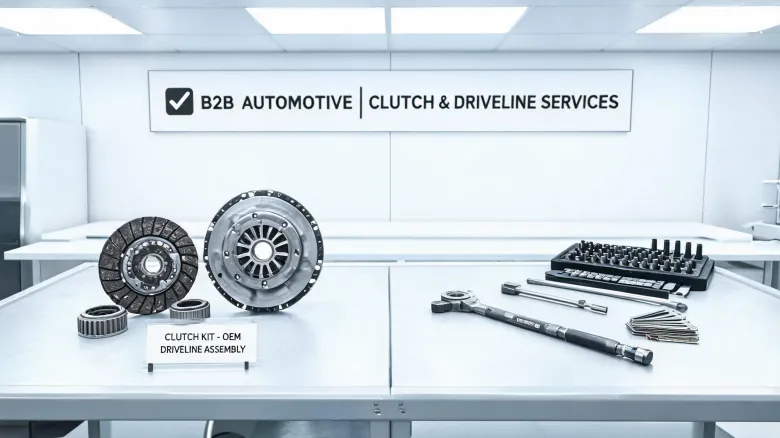
Take the Exedy Stage 1 Organic Clutch Kit (07802lb). It has a defined application range, torque rating, and OE-style feel. You don't need a factory to redesign it. You need a verified source.
A few things I tell buyers: check the part number against the exact vehicle application, then look for the Exedy logo on the box and on the components. Counterfeit clutches exist, and a fake decal is the least expensive part of a failed clutch. Authorized distributors usually carry current stock; some marketplace listings are old, reboxed, or just wrong.
Scenario 2: It's a Custom Component
Now the part has to fit a specific vehicle or layout that no off-the-shelf part matches. A good example is a bracket or pipe for a Cummins intercooler. Universal parts can fit poorly, leak, and cost more in labor than a properly engineered piece.
When I'm triaging a custom request, I look for a manufacturer with multiple capabilities: stamping, forging, aluminum extrusion, CNC machining. A shop that only stamps mild steel can make a fine bracket, but it may not be the right process for a vibrating intercooler pipe.
- Send your CAD file if you have one. If not, a physical sample plus a caliper is often enough for a fast quote.
- Ask about the material. 6061 aluminum is common, but formed parts sometimes need 5052. Stamped steel is still a legitimate choice. The cheapest material is rarely the cheapest total cost.
- Ask about verification. Dimensional report? Pressure test? Heat check? The answer tells you how the supplier treats quality.
What was best practice in 2020 isn't necessarily best in 2025. CAM software and 5-axis CNC machines have compressed lead times in ways that weren't possible even five years ago. Some principles haven't changed: fit, function, durability. But the execution has transformed.
Scenario 3: You Have a Hard Deadline
Rush orders are a different animal. The first thing I check isn't price. It's hours.
How many hours until the production line stops? Until the event starts? Until a vehicle needs to leave the shop?
For standard parts, choose a vendor that confirms a ship date in writing and use expedited shipping if needed. I once saved $80 by choosing ground shipping, then paid $400 for a rush replacement when the package missed our deadline. That's the definition of penny-wise.
For custom parts, call the manufacturer before sending a quote request. Faster.
'We can't lose Friday production. What's the fastest real option?'
In March 2024, a customer called on a Tuesday afternoon. Their line was down Friday morning and they needed a stamped bracket we had never made. Normal lead time was nine days. We pulled dies, adjusted a forming step, ran a trial sample, and loaded the parts onto a truck in about 41 hours. The customer paid $1,200 in rush fees on top of a $3,400 order. The line didn't stop. That was the trade-off.
If a supplier quotes a rush order, ask for the fallback. What happens if they miss? The right answer is 'we'll overnight it' or 'we'll credit the rush fee.' Wrong answer: silence.
Our internal policy changed after a 2023 miss. Now we ask for a 48-hour buffer on 'urgent' jobs because a Friday 5:31 pm delivery is the same as a miss.
Scenario 4: The Regulatory Question
'Is it legal to straight pipe your exhaust?' comes up more often than I'd like. Short version: removing emissions equipment—like a catalytic converter or muffler—on a street vehicle is generally illegal under federal and state laws. A 'straight pipe kit' might be sold for off-road or race use; it still doesn't make the vehicle street-legal in most places.
I'm not a lawyer, so I can't give legal advice. But I can tell you what to ask: If a vendor claims a part is 'street legal' or '50-state legal,' ask for proof. Per FTC guidance (ftc.gov), advertising claims have to be truthful and based on evidence. A vendor that can't produce a compliance statement is a liability.
For manufacturers, the question matters differently. When a customer asks us to make a downpipe that removes a DPF, we recommend a compliant path. Not because we're moralists—because a non-compliant part is a legal risk for them and for us.
How to Know Which Scenario You're In
Ask yourself three questions:
- Is there an existing part number? If yes, buy the catalog part.
- Does the part need to fit something non-standard? If yes, get a custom manufacturer involved early.
- What's the cost of being late? If a line stops or a fine shows up, schedule and compliance move to the top.
And if the request seems confusing—like something about a 'leaf spring daycare'—ask what problem the customer is trying to solve. Sometimes it's a bus. Sometimes it's a child-safety inspection. Sometimes the customer needs a specialist to translate the question.
The Bottom Line
Five years ago, 'quick' meant local stock. Now it can mean a supplier with in-house die production, CNC programs that move overnight, and a global chain that delivers in days. The industry is evolving. So are the options.
At Exedy, we see these scenarios every week. We produce stampings, dies, forged parts, aluminum extrusions, and CNC-machined components for the automotive supply chain. Some days the right answer is a standard Exedy clutch kit. Some days it's a custom bracket. Some days it's telling a customer that 'leaf spring daycare' isn't a part—but we still got their van handled.