It started with a phone call. A customer's car had a clutch that slipped in fifth gear, and they asked whether we could save money by using a cheap clutch kit. 'It's an old car,' they said. 'Not sure it's worth a big repair.'
Honestly, I understand that instinct. I manage parts buying at a 12-person independent repair shop. Our parts budget runs about $310,000 a year, and I've tracked every invoice for six years. The phrase 'cheapest option' doesn't scare me. What scares me is the second repair bill.
What the Customer Sees
From the customer's side, the problem is obvious: the clutch slips, so the clutch is bad. Replace it. Put in the cheapest disc. Done.
But after running a shop, you realize the real question isn't 'which clutch kit should I buy?' It's 'why did the old one fail, and what else was it hiding?'
Not All Clutch Kits Are Built the Same
I believed in cheap clutch kits once. It was in 2022, and we installed a no-name kit in a daily driver. The customer was happy for about 10 months. Then it slipped again. The labor cost to replace the clutch didn't change. We ate two jobs for the price of one.
I only believed in OEM replacement after that mistake. The second time, I compared the cheap kit and the Exedy kit side by side. Same car. Same labor team. Different parts. When I looked at the friction material and how the cover bolted on, I finally understood what 'matching OE spec' means. It's not about a badge. It's about tolerances.
Actually, if you search for an Exedy clutch kit, you'll see performance options and OEM replacement options. The category I care about is the Exedy OEM replacement clutch kit. Exedy's own catalog describes it as the same configuration that ships with the original clutch: cover, disc, release bearing, and in many cases a pilot bearing and alignment tool. Not an upgrade. Just the replacement that actually fits.
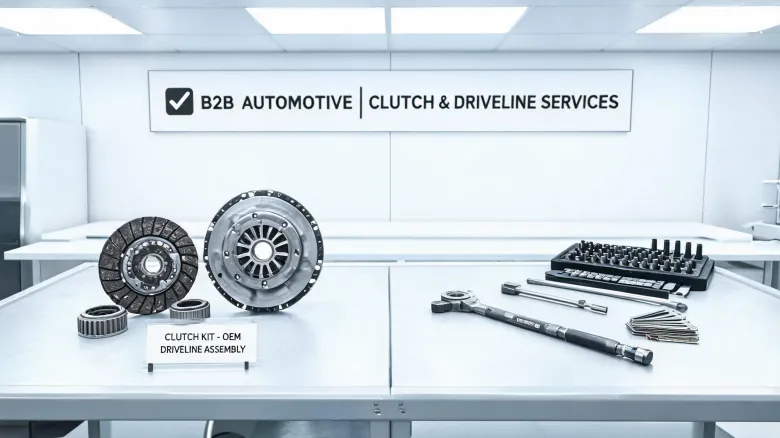
A clutch kit is basically three things: the friction disc, the pressure plate or cover assembly, and the release bearing. Sometimes a pilot bearing too. If any one of those is slightly off, you feel it in the pedal or hear it when you shift. And if the release bearing fails, the transmission comes out again. Period.
The Real Cost of a Clutch Job
Let's talk numbers. When I quote a clutch job, the part is maybe a third of the bill. Labor is the expensive part—six hours at $110 per hour adds $660. If a customer saves $100 on the part but adds 10 months and a second labor charge, the math is brutal.
I ran this through our cost tracking spreadsheet when comparing vendors for a common Toyota application. Cheap kit: $140. Exedy OEM replacement clutch kit: $240. Labor identical: $660. So the 'savings' was $100 on a $900 bill. Does that $100 justify a comeback? No. It never does.
And it's not just the part and labor. There's return shipping, the replacement parts, a loaner car if we caused downtime, and the customer's memory of the shop. The customer doesn't remember 'the kit failed.' They remember 'your shop messed up my car.' That's a brand problem, not a parts problem.
Why do I emphasize this? Because the total cost of ownership is the only number that matters. A lower quote is worthless if the repair doesn't hold. At least, that's been my experience after six years of watching the same mistake happen elsewhere.
Camshaft Adjuster Magnet Symptoms: A Diagnosis Detour
Now let me show you why the 'clutch is bad' story isn't always true. A customer pulled up one morning with a rough idle and a check engine light. The shop next door told them 'probably the transmission.' The customer searched online for camshaft adjuster magnet symptoms and found a code list. They were right to be suspicious.
A bad camshaft adjuster magnet can cause stalling, rough idle, poor acceleration, and codes like P0010 or P0013. Those symptoms can feel like a slipping clutch or a torque converter shudder, even when the clutch itself is fine. I've never fully understood why so many techs skip that check, but I've seen the result.
The fix was a $90 magnet, not a $900 clutch job. I don't have hard data on how often that happens nationwide, but based on our shop's repair notes, I'd say it's more common than people think. Lesson: get the diagnosis right before you buy any clutch kit.
Can You Drive Without a Water Pump? And Other Questions I Hear
Once we get the diagnosis right, the next questions are about everything else around the car. Three searches show up over and over:
Can you drive without a water pump?
No. Not if you care about the engine. The water pump keeps coolant moving. Drive without it, and the engine temperature climbs fast. You might make it a few minutes before serious damage starts. I've seen what should have been a $300 pump replacement turn into a $2,000 head gasket repair because somebody tried to get home.
While the transmission is out, it's worth checking the water pump if it's accessible. It's not directly related to the clutch, but you already have the labor overlap. That's the same logic I use for the clutch kit itself: pay a little more now, avoid a bigger repair later.
Does reflective brake caliper paint matter?
It matters in a different way. Reflective brake caliper paint doesn't make the car stop better. It's cosmetic. But I've seen customers ask for it during a brake job because they want their car to look clean. That's fine. The paint itself is not a mechanical fix, but it tells the owner someone cared.
My point is this: if customers care about a caliper's appearance, imagine how much they care about a clutch that works. Quality is brand image. When a customer leaves with a smooth pedal and no squeaks, they remember the experience. When they come back because a cheap part failed, the memory is the opposite.
The Simple Fix: Make Quality the Default
Here's what I do now. Every clutch quote gets an Exedy OEM replacement clutch kit as the baseline. If the customer wants a cheaper option, I show them the total cost difference, not just the part price. Then I let them choose.
I also remind them that the parts list is only half the job. The flywheel needs to be inspected. The pilot bearing should be replaced. The throwout bearing must be installed straight. Oh, and check the rear main seal while the transmission is out—that's a leak you don't want to pay for twice.
Once the diagnosis is right, the product is right, and the labor is honest, a clutch job becomes something you forget about. That's the goal. The customer stops thinking about the clutch because it works. The shop doesn't get a comeback. And the kit—usually an Exedy OEM replacement clutch kit—just does its job.
Sometimes the cheapest part is the most expensive one. In a clutch job, that's not a slogan. It's the line on the invoice.