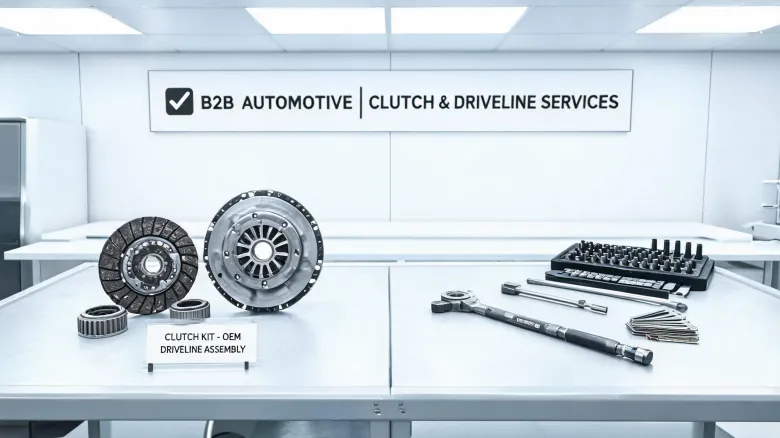
It was a Tuesday afternoon in March 2024. I was staring at an email that had my stomach in a knot. Our Q2 production line for a major European OEM was scheduled to kick off in six weeks, and the stamped clutch pressure plate components they needed—built around an Exedy pressure plate design we were adapting—were suddenly off-spec. Not by a little, either. The concentricity was out by nearly 0.2 mm. Normal tolerance is 0.05 mm. The vendor we'd contracted for the stamping die swore it was 'within industry standard' for a first article. I'd been doing this long enough to know that wasn't true. I rejected the batch.
To be fair, the rejection wasn't the problem. The problem was the timeline. Redoing a progressive die like that, with the complex geometry required for a pressure plate hub, takes time. The vendor quoted us eight weeks for a rework. We had six before the line went live. That's when the panic started, and that's when I learned how much certainty is actually worth.
The Setup: Why Exedy Specs Are Not Optional
For those who don't work this side of the supply chain, Exedy is a specific benchmark. Their design parameters for a clutch system, especially a performance-oriented kit like you'd see spec'd for a 350z Exedy clutch kit, are tight. The diaphragm spring loads, the rivet patterns, the facing material—everything is engineered to a specific tolerance stack. If your stamped pressure plate is out of spec, the whole clutch engagement profile shifts. It's not a cosmetic issue. It's a safety and drivability issue, and it gets flagged immediately by any competent Tier 1 buyer.
Our customer wasn't a mom-and-pop shop. They were a Tier 1 supplier assembling clutch modules for a global OEM. They had their own quality check at incoming inspection. If our parts didn't land within their spec window, they'd be rejected on the dock, and we'd be staring at a $22,000 redo plus a delayed launch penalty. I'd seen that exact thing happen to a competitor in 2022. It cost them the contract.
The Turning Point: Choosing Between a Gamble and a Guarantee
After we rejected the die, the vendor offered us a compromise. They could 'speed up' the rework for a 30% premium on the original die cost, but they couldn't guarantee the timeline. Their production scheduler said it was 'likely' to cut it to six weeks. 'Likely' isn't a deadline. 'Likely' is how you miss a launch.
So I started calling around. I needed a die shop that could not only hit the Exedy tolerance spec but could do it on a compressed schedule. I found a shop about 400 miles away that specialized in progressive dies for automotive stamping. They had experience with clutch components. They quoted me a price that was $4,200 higher than the rework quote from the original vendor. But here was the kicker: they said they could do it in five weeks, guaranteed, with a penalty clause in the contract if they missed.
That $4,200 was essentially a rush fee for certainty. The original vendor's rework quote was cheaper. The new shop's quote was higher but came with a hard deadline. I didn't hesitate. I signed the PO that afternoon.
The Result: What $400 Extra Per Part Actually Bought Us
The die arrived in five weeks and one day. The one-day delay was due to freight, not production. The die itself was perfect. The first article stamped parts checked out against the Exedy spec with zero deviations. We ran the entire Q2 order—something like 12,000 units—without a single quality issue from that die.
Let me break down the math. The extra die cost was $4,200. On a run of 12,000 parts, that's $0.35 per part. The cost of missing the launch would have been roughly $22,000 in redo costs plus a penalty of around $5,000 per day for line downtime. Even a three-day delay would have cost us $37,000. The $4,200 investment saved us from a potential $37,000 loss. That's a 9:1 return on certainty.
The Lesson: Paying for Uncertainty Is More Expensive Than Paying for Certainty
Here's something vendors won't tell you: their 'standard' turnaround time often includes buffer. It's a scheduling cushion. When they offer to 'rush' an order, they're often just compressing that buffer. It doesn't change their actual production queue. A guaranteed rush order, on the other hand, requires them to allocate dedicated resources—people, machine time, inspection capacity—specifically to your job. That's why it costs more. You're not paying for speed. You're paying for dedicated capacity.
This was accurate as of Q2 2024. The market for precision stamping dies has been volatile since the supply chain disruptions of 2022-2023. Lead times and premiums shift. But the principle hasn't changed: when the cost of failure exceeds the cost of certainty, the obvious choice becomes clear.
Honestly, I'm not sure why more procurement managers don't build this into their risk calculations. My best guess is they get stuck on unit price. They see the line item for a rush fee and think 'that's expensive' without running the downstream cost of a missed deadline. It's a mindset shift. It took me about 150 orders and one near-disaster to really get it.
From the outside, it looks like the rush fee is a premium for speed. The reality is you're paying for a guarantee. For critical projects—our Exedy project was one of them—the guarantee is what you actually need.